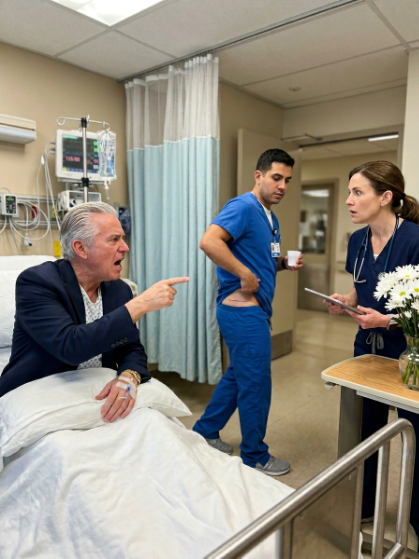
“Get me someone competent. I am paying for this room.”
Theodore Whitcomb said it at three-thirty on a Tuesday afternoon in October, in a private ICU room at Boston Mass General Hospital, propped against two pillows in his hospital gown with a navy blazer thrown over his shoulders against the air-conditioning, an IV taped to the back of his left hand, a gold watch he had insisted on wearing on his right wrist. He said it loud enough that the patient in the next room could hear it through a half-drawn curtain. He said it to a young orderly in beat-up gray sneakers who had brought him the wrong-size cup.
Theodore was sixty-three years old, two days post-procedure, recovering well, and irritated with the food, the lighting, the temperature, the volume of the television, and the speed at which his bedpan had been cleared that afternoon. The orderly — a young man named Carlos in blue ICU scrubs over a plain white tee — said, “Yes, sir,” took the wrong cup back, and turned to leave for the supply closet down the hall.
Carlos did not slam anything. He did not roll his eyes. He had been a patient himself in this exact wing of this exact hospital, two years and four months ago, and he had learned, lying flat for fourteen days with a drain in his side, that you do not give arrogance a foothold by reacting to it.
What Carlos did not know was that as he turned, his blue ICU scrubs rode up at his right hip, just an inch — enough to expose, for less than a second, a thin pale surgical scar that ran in a clean curve along the side of his belly.
Margaret Hayes saw it.
Margaret was the ICU charge nurse on duty, forty-two years old, brown hair pulled into a low ponytail, navy scrubs, stethoscope around her neck, slim tablet in her right hand. She had been crossing the room to check Theodore’s IV line. She had seen scars in this wing for sixteen years. She knew which scars were appendix and which were gallbladder and which were transplant. She knew, very specifically, what the scar at Carlos’s right hip was. She had been on duty the morning of his procedure.
She stopped mid-stride beside Theodore’s bed. Her tablet half-rose. She did not say anything to Theodore. She did, with one finger, pull up the family chart on Theodore’s record. She scrolled to the next-of-kin associated dependents file. She read for four seconds.
Then she walked back to Theodore’s bedside, looked from the scar at Carlos’s hip — Carlos was nearly at the door now — to Theodore, and said, in the same even voice she used for vital-signs updates: “Mr. Whitcomb. The orderly you just dismissed donated thirty percent of his liver to your niece in this exact ward two years ago.”
Theodore’s pointed finger lowered. His mouth, for the first time that afternoon, closed.
Carlos, at the door, paused. He did not turn around. He did, very quietly, set the wrong-size cup down on the supply cart in the hallway.
“What,” Theodore said.
“Your niece Lily Whitcomb,” Margaret said. “Eight years old at the time. Diagnosed with biliary atresia. End-stage. She had been on the directed-donor list for nine months. She received a partial-liver transplant in this ward in October two years ago. The donor was listed in your sister’s records as ‘anonymous, hospital-affiliated.’ Your family declined to be told the donor’s identity at the time, per the donor’s written request. Carlos signed a non-disclosure waiver as a condition of the directed donation. He said he did not want the family to feel they owed him anything.”
Theodore did not speak for a count of four.
“Lily is doing very well now,” Margaret said. “She turned eleven last month. Her mother brings her cookies for the staff every Christmas. She was here two weeks ago for her annual labs. She did not see Carlos because Carlos works the morning shift on Tuesdays and her appointment was on a Friday afternoon. He has, on three occasions, asked her mother how she is doing without identifying himself.”
Theodore looked at Carlos. Carlos was still standing at the door, back to the room, one hand on the doorframe.
“Carlos,” Theodore said. His voice was very small.
Carlos turned around. He did not look angry. He looked tired in the way that thirty-two-year-old men who have lived through a major surgery and a long recovery look tired by mid-afternoon. He had a hospital ID badge clipped to his chest that Theodore had not, in two days of being in this room, looked at once.
“Yes, sir,” Carlos said.
“Why,” Theodore said.
“My sister died of liver failure when she was twenty-six,” Carlos said. “Untransplanted. We could not afford the directed-donor process. I was nineteen. I have been on the universal-donor list since I was twenty-one. Lily came up as a near-match through the directed-donor cross-reference last year. I did not know she was your niece. I did not know who you were until you arrived in this room two days ago. I would have made the same decision either way. I am sorry I brought you the wrong cup.”
He took a breath.
“I will go get the right one now.”
He turned. He walked out of the room.
Theodore Whitcomb did not say anything for the next eleven minutes. Margaret finished checking the IV. She adjusted the privacy curtain. She left the room without saying anything else, because she had, in sixteen years of ICU work, learned which silences not to fill.
That evening, Theodore tried to write Carlos a check.
Carlos refused it. He said it three times, very politely, in the doorway of Theodore’s room. He said the donation had been anonymous, the recovery had been covered by the hospital’s living-donor program, and there was no debt to repay.
Then Carlos said: “If you would like to do something, sir, the hospital’s living-donor support program is underfunded. We need a recovery wing for donors who can’t afford to take eight weeks off work. I lost my apartment during my recovery. I am not the only one.”
Theodore Whitcomb wrote the check the next morning. He wrote it for one million two hundred thousand dollars. He had it routed to the hospital foundation’s living-donor wing development fund. He wrote a separate check, on the same morning, for two hundred thousand, made out to a fund the foundation set up that month called “Carlos Mendez Family Emergency Reserve.”
Carlos found out about the second fund six weeks later, when his supervisor called him into the social worker’s office and told him that the fund existed, that it had his name on it, and that he could not refuse it because it was already legally established and he was not the only beneficiary.
Carlos sat in the office for a long time.
Then he said, “All right. But please tell Mr. Whitcomb that the cup he gave me to drink from on Wednesday morning was the wrong size. Tell him I noticed.”
The social worker laughed. She wrote it down. She walked it down to the recovery wing, where Theodore was, on that Wednesday afternoon, getting ready to be discharged, and she handed it to him on a sticky note.
Theodore read it. He folded it. He put it in his wallet. He carried it for the rest of his life.