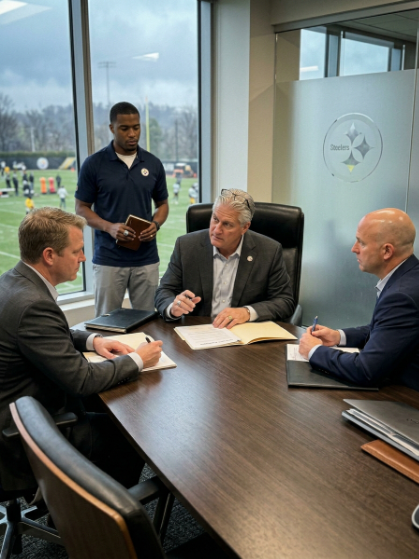
He walked into the front-office conference room late.
Marcus Stone, twenty-nine years old, franchise quarterback of the Pittsburgh Steelers, came in still damp from the morning workout in a navy team-logo polo over a plain white tee, athletic gray pants, a Super Bowl ring on his right hand catching the gray overcast light from the floor-to-ceiling windows. He sat down at the back end of the dark wood conference table, two chairs from the head, the seat normally reserved for the offensive coordinator on draft-prep days. Nobody asked him to leave. He was, after all, the franchise quarterback.
He had a small leather notebook in his left hand.
The other men in the room — team president Donald Greer at the head, two front-office executives flanking him in matching gray suits, the head of legal in the corner, the outgoing chief of staff at the far end — had been working through the quarterly contract review for an hour. They were six pages in. Most of the items were rubber-stamps. Two were non-renewals. The first non-renewal had already been signed.
The second non-renewal was item nine on the agenda.
Donald turned the page. He read aloud, the way he had been reading aloud for the previous hour: “Watts, Henry. Team chaplain. Twenty-two years of service. Annual stipend forty-eight thousand. Recommendation: non-renewal. Rationale: no measurable return on investment, and chaplaincy services are now available through the league’s outsourced wellness program at zero cost to the franchise.”
The two execs flanking Donald clicked their pens above the page.
Marcus Stone, at the back of the table, stood up.
He didn’t speak yet. He just stood. The polo at his collar was still damp from the workout. The small leather notebook was in his left hand at his side, closed, the way you hold a book you have been carrying around for a long time.
Donald looked up. His pen was mid-stroke above the contract page. He stopped. The two execs stopped. The chief of staff stopped. The head of legal, who had been on his phone, looked up.
“Mr. Stone,” Donald said. “Did you have something.”
“Sir,” Marcus said. “Before you sign that. May I speak.”
Donald set his pen down. He did not say yes. He did not have to.
Marcus opened the leather notebook.
The notebook was the size of a small Bible. It was leather-bound, cracked at the spine, with the gold lettering long since worn off the front. Marcus had been keeping it for eleven years. The first entry was from January 2014, the night he had received it as a high-school-graduation gift from his mother. The rest of the notebook — every line in his own careful handwriting — was a ledger.
It was a ledger of Pastor Henry Watts.
“Pastor Watts buried Daryl Cooper’s son in May of two thousand fifteen,” Marcus said, reading without looking up. “Daryl was on injured reserve at the time. The team did not send anyone to that funeral. Pastor Watts drove from Pittsburgh to Cleveland and back in one day. He paid for the headstone out of his own pocket. He told Daryl he had taken up a collection. There was no collection.”
The room was very quiet.
“Pastor Watts married Trevor Lawson and his wife in two thousand seventeen at three a.m. on a weekday because Trevor was on a road trip and they needed to be married before his daughter’s adoption hearing went through that Friday. He did not charge them. He did not bill the team.”
He turned a page.
“Pastor Watts has been paid forty-eight thousand dollars a year for twenty-two years. The IRS files an extra schedule on him every year because he gives away approximately sixty percent of his stipend to the families of the people on this team. I have a copy of his tax return from last year. He gave it to me because I asked. He did not want to. I had to convince him by promising I would not show it to anyone.”
Donald, at the head of the table, was looking at his contract folder without seeing it.
“Eleven years ago,” Marcus said, “my sister Sarah was nine years old. Acute lymphoblastic leukemia. We lived in a town outside Cleveland. The hospital was in Pittsburgh. My family did not know anyone here. I was eighteen. I was a freshman commit at Ohio State. My sister was dying.”
He turned the page.
“Pastor Henry Watts drove from Pittsburgh to Cleveland six times in the last three weeks of her life. He sat with her. He read to her. He prayed with her. He did not know me. He did not know my family. He read about her case in the Plain Dealer because a hospital nurse who attended his Wednesday-night service had mentioned it. He drove six hours round trip, six times, on his own gas, because a child was dying and he had time to spare.”
He paused.
“My sister died on a Sunday morning. Pastor Watts was in the room. He said the Twenty-Third Psalm at her bedside. He drove my mother to the funeral home that afternoon because my father could not drive. He drove her home. Then he drove back to Pittsburgh and preached the eleven o’clock service the next morning.”
He looked up from the notebook for the first time.
“I did not meet him until six years later, when I was traded from Cincinnati to Pittsburgh and he came to my locker on my second day and shook my hand. He did not introduce himself the way a chaplain introduces himself to a quarterback. He introduced himself the way an old friend introduces himself to someone he has loved without their knowing it.”
He closed the notebook.
“Last year,” Marcus said, “the night before the championship game, I called him at two in the morning. I was about to lose my mind. He drove four hours from his daughter Hannah’s bedside in Cleveland to be in my hotel room before kickoff. His daughter had pancreatic cancer. He had been with her for four days straight. She died at six-forty-seven a.m. that morning. He preached the team’s pre-game devotional anyway because he had made me a promise eleven years ago. He did not tell anyone in this room that his daughter had died. He preached. He cried after. He did not bill us for the four-hour drive.”
Marcus looked at Donald.
“Sir, with respect, I will not play for a franchise that cuts that man over a forty-eight-thousand-dollar line item. I am asking you to scratch the non-renewal. I am also asking you to double the stipend. I will personally pay half of the increase out of my own check. The franchise will pay the other half. That is the deal.”
Donald looked at the two front-office executives flanking him. They had not, at any point in the previous five minutes, moved their pens.
He picked up his pen. He scratched the non-renewal line. He wrote, in the margin: STIPEND DOUBLED, EFFECTIVE IMMEDIATELY. CONTRACT EXTENDED FIVE YEARS. He initialed it. He passed the folder to his right.
The two execs, very quietly, signed under his initials.
Marcus closed the notebook. He sat down.
The contract review continued.
Pastor Henry Watts found out that his stipend had been doubled and his contract extended five years on the following Sunday morning, when Marcus Stone walked into the team chapel before the home game and put a contract folder on the lectern beside the open Bible. Pastor Watts did not open the folder. He did, on Marcus’s request, preach the morning service. The text was Psalm Twenty-Three.
After the service, Marcus shook his hand the way he had shaken it twelve years before, in a hospital corridor in Cleveland, when Marcus had been a freshman commit and a brother and, for that one terrible week, neither.
He did not say thank you. He had stopped trying to say thank you eleven years ago. He had been keeping a notebook instead.