The sigh had been going on for ten minutes.
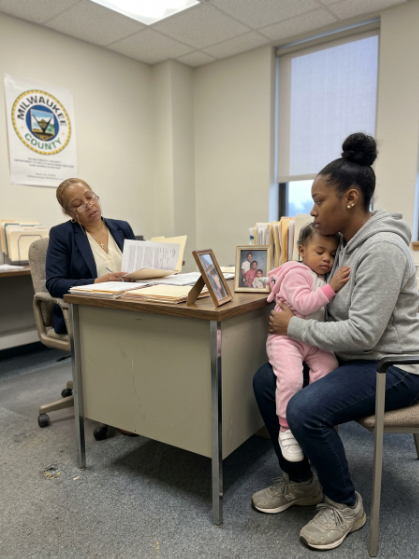
Not a single sigh — Patricia Hall did not do anything so obvious. It was a series of small exhalations, each one timed to the turning of a page in Tasha Williams’s client file, each one carrying a particular weight of professional disappointment that Tasha had been hearing from people behind desks her entire adult life. Patricia sat behind the laminate desk in her small office at the Milwaukee County Department of Health and Human Services in a navy blazer over a cream blouse, a small gold cross necklace at her throat, reading glasses sliding down her nose, flipping pages. Tasha sat across from her in a heather-gray hoodie over a tee, dark jeans, beat-up running shoes, her two-year-old daughter Aaliyah in a pink unicorn onesie half-asleep on her left hip.
It was nine-forty-seven on a Wednesday morning. The fluorescent lights buzzed. The industrial-gray carpet was scuffed at the threshold. Aaliyah’s small hand rested on Tasha’s hoodie collar, fingers curling and uncurling in the rhythm of almost-sleep.
“Ms. Williams,” Patricia said, not looking up. “Your file is — frankly — concerning.” She turned another page. Sighed. “Late paperwork. Two missed appointments. A change-of-address form that was apparently submitted in April but never received.” She looked up over her reading glasses. “Have you considered whether you are equipped for full custody?”
Tasha did not argue. She had been sitting in offices like this since she aged out of foster care at eighteen. She had learned, very early, that the people behind these desks did not hear arguments. They heard tone. And tone, in rooms like this, was the only thing that could be used against you.
She adjusted Aaliyah on her hip. She said, very evenly: “I missed appointments because I work two jobs and my daughter’s daycare closed in June. The paperwork is late because the address you have on file is wrong. I sent the change form in April. I have the certified-mail receipt in my bag.”
Patricia’s mouth thinned. She wrote something in the margin of the file. She did not ask to see the receipt.
Tasha breathed. She let her eyes move around the small office — the county-seal poster on the wall, the stacked file folders, the half-drawn window blind. And then her gaze stopped.
On the edge of Patricia’s desk, angled slightly toward the wall but still visible from the visitor’s chair, was a small framed photograph. Late nineteen-nineties, judging by the color. Two adults and three children at a backyard barbecue. Folding chairs, paper plates, a grill smoking in the background. The youngest child — the one on the lap of a younger Patricia — was a Black baby girl in a yellow sundress, maybe eleven months old, one hand gripping Patricia’s collar.
Tasha’s breath stopped.
She knew that sundress. She had seen it in a photograph her adoptive mother had kept in a shoebox in the hall closet, a photograph Tasha had found at sixteen and studied for hours and never asked about.
Her free hand went, very slowly, into the front pocket of her hoodie. The folded printout was there — the same one that had been there since six a.m., when she had read it three times in her parked car before walking into this building. Fifty percent match to P. Hall, Milwaukee metro area. Parent-child relationship: confirmed.
Tasha looked at the baby in the photograph. She looked at Patricia. She looked at the baby again.
“Mrs. Hall,” she said. Very quietly. “Where was that picture taken.”
Patricia looked up. Her pen paused. She followed Tasha’s gaze to the photograph on her desk. Something moved behind her eyes — a flicker, quick and controlled, like a bird startling in a cage.
“That’s a family photo. From a barbecue. Nineteen ninety-seven, I think.”
“The baby,” Tasha said. “In the yellow sundress.”
The room was very quiet. Aaliyah shifted on Tasha’s hip and made a small sound.
Patricia’s hand moved toward the photograph, then stopped. She looked at Tasha — really looked, for the first time since the appointment started. She looked at Tasha’s face the way you look at a face when you are suddenly, terribly afraid that you recognize it.
“Why are you asking,” Patricia said. Her voice was different now. Smaller.
Tasha pulled the folded printout from her hoodie pocket. She unfolded it. She set it on the desk between them, next to the open client file, next to the photograph of a baby in a yellow sundress.
“My name before adoption was Tasha Marie Hall,” she said. “I was born March fourteenth, nineteen ninety-six, at St. Joseph’s Hospital in Milwaukee. I was placed for adoption at eleven months through sealed records. I was adopted by the Carter family in Waukesha County. The Carters are cousins of the Hall family. I grew up calling you Aunt Patty until I was eight, when your family and mine stopped speaking.”
Patricia did not move. Her reading glasses slid the rest of the way down her nose and she did not push them back up.
“I did a DNA test six weeks ago,” Tasha said. “Fifty percent match to P. Hall, Milwaukee metro. Parent-child relationship confirmed. I have been carrying this paper in my pocket for six weeks trying to decide how to tell you. I did not expect to be sitting across from you at DHHS being asked whether I am equipped for custody of my own daughter.”
The fluorescent light buzzed. Aaliyah’s small fingers curled tighter into Tasha’s collar.
Patricia’s hand was on the edge of the desk. Her knuckles were white. She was looking at the DNA printout the way you look at something you have been waiting for and dreading in equal measure for twenty-nine years.
“Tasha,” she said. It was the first time she had used her first name.
“I’m not here to make a scene,” Tasha said. “I’m not here for anything except to know. And now I know.” She folded the printout. She put it back in her pocket. “I would also like my address change processed and my file updated to reflect that I have not missed any appointments since June’s were rescheduled by your office, not by me.”
Patricia opened her mouth. Closed it. Opened it again.
“Tasha,” she said again. Her voice cracked on the second syllable. “I was nineteen. I was nineteen years old and I did not — I could not—”
“I know,” Tasha said. “I’m not asking you to explain. I’m twenty-nine. I have a daughter. I understand what nineteen feels like better now than I did a year ago.”
She stood up. Aaliyah stirred, pressed her face into Tasha’s neck.
“I would like,” Tasha said, “for my daughter to know her grandmother. If you want that. But not today. Today I need my file updated.”
Patricia looked at her — at the baby she had held in a yellow sundress in 1997, at the woman standing in her office in 2025, at the child on her hip who had Patricia’s mother’s chin.
“The file will be updated today,” Patricia said. Her hand was shaking. “The address change will be processed today. I will handle it personally.”
Tasha nodded.
“And Tasha,” Patricia said. She took off her reading glasses. Her eyes were wet. “Saturday. If you want. I still live on Forty-Third Street. Same house. Same backyard.”
Tasha looked at the photograph on the desk — the barbecue, the folding chairs, the baby in the sundress.
“Saturday,” she said. “I’ll bring Aaliyah.”
She walked out of the office. Aaliyah’s small hand stayed curled in her collar all the way to the parking lot. In the car, Tasha sat for three minutes with the engine off and her forehead against the steering wheel.
Then she put the car in drive and went to work.