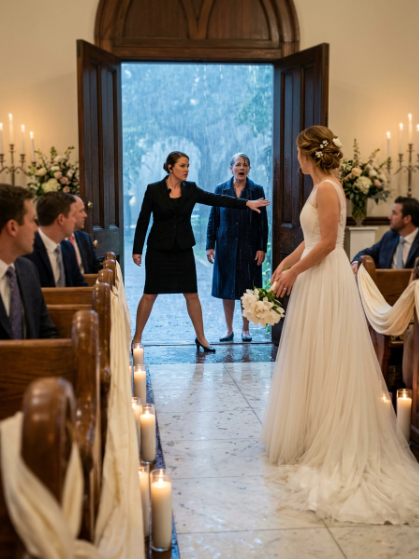
The lullaby hung in the chapel air like something alive. Sandra’s arm stayed outstretched across the doorway, her earpiece forgotten, crackling with unanswered static, because every guest in Magnolia Chapel had stopped breathing. The organ player lifted her fingers from the ivory keys and let them hover, uncertain, above a hymn that no longer mattered. Candles along the marble aisle flickered in the draft from the open double doors where rain hammered the stone steps and pooled at the threshold, and a woman in a soaked navy coat stood singing a melody that made Nora Sinclair’s entire body go rigid.
The bouquet hit the floor. White peonies scattered across marble already slick from the growing puddle at the threshold. Nora turned fully now, chapel-length train twisting and catching on a pew corner, both hands empty and trembling at her sides. She knew. Somewhere beneath twenty-five years of grief and a death certificate signed in Chatham County and a father who never once spoke about it, she knew that voice belonged to someone who was supposed to be ash and memory and a closed casket her grandmother wouldn’t let her see.
Grace Adler didn’t push past Sandra. She didn’t need to. The melody carried itself through the warm amber candlelight, through the silk draping on pews, through a hundred held breaths from guests whose champagne was getting warm in the reception hall next door. Her burn-scarred hands stayed at her sides — those old ridged maps across both knuckles, healed but never hidden. Short gray hair plastered flat against her skull. Navy coat darkened almost black by rain, water dripping from its hem onto the marble. She sang the second verse — the verse Nora’s father had recorded on a handheld device in a hospital room when Nora was three days old. The verse that existed on one cassette tape, in one bedside drawer, in one house Nora grew up in.
Sandra finally dropped her arm. Not because she chose to — her coordinator training screamed to maintain the perimeter — but because the bride was walking backward. Ivory heels clicking wrong-direction on marble. Every professional instinct said stop her, but Nora moved toward the doors in her tulle gown with her train dragging through the puddle, her lips moving around syllables she hadn’t spoken since childhood. Her maid of honor — stepsister Rachel — rose from the front pew with her hand over her mouth.
The groom, Michael, stood alone at the altar. His boutonniere was slightly crooked. He watched his bride walk away from him toward a stranger, and he didn’t move to stop her. He’d spent three years with Nora. He knew what the lullaby tape meant. He knew about the nightmares. He knew about the fire.
Patricia — the groom’s mother, seated front row left — gripped the pew rail with white knuckles. She’d been the one to handle everything twenty-five years ago. She’d been on the school board with Nora’s father. She’d been the one to tell four-year-old Nora that Mommy went to heaven in the fire. The burns had been catastrophic, the identification dental only, the body released without the family seeing it. But Patricia had also been the one to decline the DNA confirmation when the medical examiner’s office offered it six months later. Faster to grieve. Cleaner to close the chapter. And by then, Nora’s father had already met his second wife.
Grace stopped singing when Nora reached the third pew from the back. Twelve feet of marble and rainwater between them. The chapel was so quiet that the rain pouring outside sounded like a standing ovation from an audience they couldn’t see.
“They told me you were dead.” Nora’s voice cracked on the last word and splintered into something between a whisper and a sob.
Grace’s scarred hands rose slowly, palms up, trembling, like someone showing she carried no weapons and wanted nothing except to be seen. “I was, sweetheart. For a long time, I was.” Her voice was rough at the edges — damaged by smoke inhalation and years of silence — but melodic underneath, the way a river sounds beneath ice. “The burn unit kept me under a different name for nine months. The hospital made an error with identification, and by the time I could speak again and tell them who I was, your father had moved you to Savannah. I tried to come. There was a restraining order.”
Nora’s chin trembled. “A restraining order. From who?”
Grace’s eyes moved — just briefly — to the front pew. To Patricia, who was now staring at the floor. “I never understood who filed it. I only knew I couldn’t get within five hundred feet of my daughter without being arrested.”
Rachel looked at Patricia. Two donors in the second row looked at Patricia. The understanding traveled through the chapel like electricity through water.
“I’ve been in Savannah for three years,” Grace continued. She didn’t step past the threshold. Rain continued to fall on her shoulders. “I work at the bookstore on Broughton Street. The one with the green awning. I’ve watched you walk past the window on Tuesdays and Thursdays with your coffee. I couldn’t — I didn’t know how to begin.” Her voice broke apart entirely. “I heard about the wedding. I just wanted to hear you say your vows. I was going to listen from outside. I never meant to sing. But Sandra was closing the doors, and I knew once they closed I might never—”
Nora crossed the remaining distance in three steps. Her ivory heels splashed through the puddle at the threshold. She reached Grace, and her hands found the burn scars — those old ridged roads across her mother’s knuckles — and held them tight enough to turn both their fingers white. Grace’s hands curled around her daughter’s and held on like a woman gripping a lifeline in a current.
Michael walked down the aisle. Not toward Grace — toward Nora. He put his hand on the small of her back, solid and certain. “Take whatever time you need. I’ll be at the altar.”
The photographer — hired for bouquet tosses and first dances — took one photograph from the fifth pew. Two women holding hands in a doorway while rain fell behind them and amber candlelight fell before them. It was printed once, in one frame, and placed on the family mantel above the fireplace.
The wedding continued forty-two minutes late. Patricia left during the delay. She gathered her clutch, walked out through the service entrance, and drove home without speaking to anyone. The restraining order, Nora learned in the weeks that followed, had been filed by Patricia and Nora’s stepmother together — not by her father, who’d died two years prior still believing Grace had perished in the fire.
At the reception, Grace sat at the family table in a borrowed dress — seafoam green, slightly too large, lent by Michael’s aunt. Nora’s hand found her mother’s beneath the table during every toast. When the DJ played the first dance, Nora asked Grace to stand with her on the floor. They swayed without music for a moment before the song began.
The lullaby was sung one final time that night. Not in a chapel doorway but in the bridal suite, two women sitting on the edge of the bed still in their event clothes — one in ivory tulle, one in borrowed seafoam — the melody finally belonging to both of them.
Grace left the soaked navy coat hanging over a chapel pew. She never went back for it.