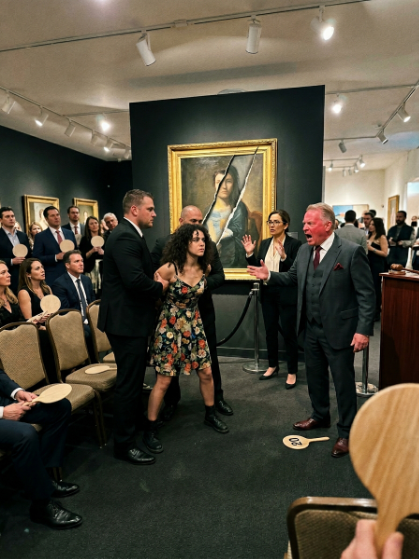
The auctioneer’s hand was six inches above the gavel when Zara Hayes cleared the velvet rope at a dead sprint. Lot 47 — the Mercer portrait — had thirty seconds remaining before three point two million dollars changed hands and the last evidence of her grandmother’s existence disappeared into a private collection forever. She’d calculated the timing for three weeks. Watched four previous Saturday auctions from the back row. Counted the seconds between final bid and hammer fall. Tonight she wore flat shoes.
Security reached her two seconds too late. The slash went through the gilt-framed canvas with a box cutter she’d carried past the metal detector in the spine of a hardback catalogue — one clean vertical tear that parted oil paint like skin. The portrait of Grant Mercer’s yacht opened down the center, and behind the rip, different brushstrokes appeared. Older pigments in a completely different palette — warm ochres and deep magentas where the portrait above held only blues and chrome. A different hand entirely. Track lighting caught the exposed layer as gasps cascaded through rows of upholstered auction chairs.
Two guards in black suits seized Zara’s arms from behind and pinned them at the small of her back. Her box cutter clattered to the gallery floor. Dark curly hair fell wild around her shoulders, one dress strap held together by a safety pin. The secondhand floral dress had cost four dollars at Goodwill. She didn’t struggle. She planted her feet and stared straight at the torn canvas with eyes that burned steadier than the outraged billionaire now rising from his front-row seat.
Grant Mercer’s face went from ivory to crimson in three seconds. His auction paddle hit the floor. His burgundy pocket square caught track lighting as he jabbed a finger toward Zara. “That painting is worth three million dollars. I want her arrested. I want charges filed tonight. Criminal destruction of—”
“Mr. Mercer.” Dr. Nina Rao’s voice cut through his tirade like a scalpel through noise. The gallery authenticator had risen from her reserved seat in the third row and was already three steps from the damaged canvas. Tortoiseshell glasses reflecting track light. Black blazer perfectly pressed over a cream blouse. Her hands rose toward the tear — trembling visibly — and stopped inches from the exposed underlayer. She didn’t touch it. A trained authenticator never touches damaged work without gloves. But her face — that was what silenced Mercer mid-sentence. Her expression had transformed from professional alarm into something closer to reverence.
“Everyone stay where they are.” Rao’s voice carried the authority of someone who’d authenticated over four hundred works in her career. “Nobody touches this canvas. Nobody moves it.” Her eyes were locked on the brushstrokes visible through the slash — the distinctive cross-hatching, the layered impasto technique, the way warm pigment met cool in deliberate collision.
“What is it?” The auctioneer leaned over his podium.
Rao turned to face the room. Her hands still trembled at her sides. “This is a Rosalind Hayes original. The brushwork is unmistakable — I studied her technique for my doctoral thesis at Stanford. She disappeared in 1987 and was declared dead in 1993.” She looked at the torn canvas. “Someone painted over her work.”
The room went completely silent except for the ambient hum of track lighting. One hundred and forty seated bidders processed this information at different speeds. The name Rosalind Hayes meant different things to different people in this room — some recognized it from art history, others from the notorious disappearance, others not at all.
Zara spoke for the first time. Her voice was steady despite the guards’ grip on her arms. “Her name was Rosalind Hayes. She was my grandmother.”
Every head turned.
“In 1986, Grant Mercer was a gallery owner in North Beach. He represented my grandmother exclusively. He controlled her sales, her commissions, her access to buyers.” Zara’s chin lifted. The guards’ hands were tight on her biceps but she spoke like a woman addressing a courtroom. “When she refused to sign over reproduction rights to her entire catalogue, he locked her out of her own studio. Changed the locks. Kept forty-three canvases inside. She couldn’t afford an attorney. She left San Francisco and never came back.”
Mercer’s face had passed through crimson into something gray. “That’s — those are unsubstantiated accusations from—”
“The canvases were listed as destroyed in a storage fire in 1988,” Zara continued, ignoring him. “Mercer collected the insurance. But he didn’t destroy them. He painted over them — his own mediocre portraits on top of her work — and sold them for decades as original Mercers.” She nodded toward the slashed portrait. “That canvas underneath is Rosalind Hayes’s Sunset Meridian. It was her masterpiece. Completed in 1985. Last seen in Mercer’s gallery in 1986.”
Dr. Rao had put on white cotton gloves — produced from her blazer pocket — and was examining the exposed underlayer with a penlight. Her hands had stopped trembling. Professional mode had taken over. “The pigment age is consistent with mid-1980s oil work. The cross-hatch technique matches Hayes’s documented style exactly. If this is verified—” She looked up at the room. “A Rosalind Hayes original in this condition would be valued between fifteen and twenty-two million dollars. The canvas Mr. Mercer was selling for three million has a painting worth seven times that hidden beneath it.”
The auctioneer set his gavel down. He wasn’t going to need it.
Mercer’s attorney — a thin man in the second row — was already on his phone. Mercer himself stood motionless in his charcoal three-piece suit, the pocket square now looking less like confidence and more like a flag at half-mast. Around him, bidders who’d been competing for his portrait were pulling out their own phones, documenting, texting, the word spreading in real time.
“I have documentation,” Zara said. Her voice didn’t waver. “My grandmother kept carbon copies of every invoice, every contract, every letter she sent Mercer requesting her canvases back. I have the insurance adjuster’s original photographs showing the canvases before the supposed fire — the same dimensions as Mercer’s portrait inventory. I brought everything to the district attorney’s office this morning.”
Mercer sat down. Not in his chair — he missed it — but on the armrest, which tilted sideways. He caught himself on the chair beside it. Nobody helped him.
The security guards looked at each other over Zara’s head. One of them quietly released her right arm. The other followed. She stood unrestrained in the center of Harrington Gallery, secondhand floral dress and safety-pin strap, surrounded by people whose combined net worth exceeded a billion dollars. She looked only at the canvas — at her grandmother’s brushstrokes visible through the tear, forty years hidden, finally breathing gallery air.
Dr. Rao approached Zara. Removed her white gloves and extended her hand. “I’d like to lead the authentication personally. Pro bono. If you’ll allow it.”
Zara shook it. Her hand was steady.
Three weeks later, X-ray imaging confirmed Rosalind Hayes originals beneath eleven of Grant Mercer’s portraits in private collections across three countries. Total estimated value of the hidden works: ninety-four million dollars. Mercer’s assets were frozen pending fraud investigation.
Zara Hayes sat in Dr. Rao’s office at Stanford with a cup of coffee and her grandmother’s carbon-copy letters spread across the desk. The box cutter that started everything was in an evidence bag downtown. The secondhand floral dress hung in her closet.
She kept it. Four dollars at Goodwill. It had done its job.