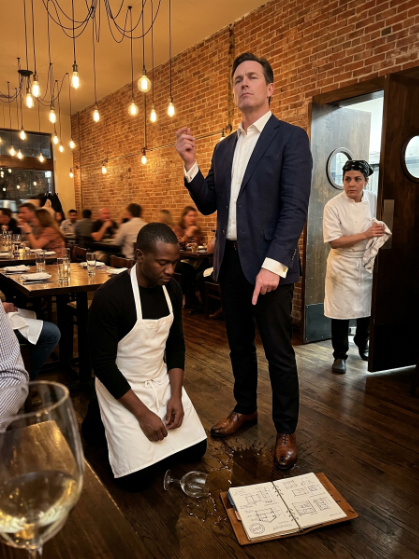
The leather notebook lay open on the wet hardwood floor, architectural sketches staring up at the Edison-bulb ceiling of The Pearl Bistro like an accusation no one could read yet. Water from the toppled glass spread beneath its pages, soaking into drawings that mapped the exact renovation — the exposed brick archway between dining rooms, the relocated bar, the custom lighting track — that had saved this restaurant from demolition two years ago. Stamped approvals in faded ink bled at the edges where water touched them.
Victor Harding snapped his fingers a third time. The gold cufflinks threw amber sparks in the warm overhead light. “I said on your knees. Properly. You’re going to wipe my shoe with that apron and then you’re going to get me your manager.” His voice carried across six nearby tables. Three couples studied their plates. One woman signaled urgently for the check. A man at the bar set down his bourbon and turned to watch.
Daniel Okafor didn’t rise from where he’d fallen. He stayed on one knee, close-cropped hair catching the Edison-bulb glow, white busboy apron darkened by spilled water, face calm as poured concrete. Not afraid. Not angry. Not performing restraint for an audience — simply existing in the stillness that had become his entire vocabulary since the night on Lamar Boulevard when glass shattered and metal folded and his wife stopped breathing in the passenger seat and his own voice left his body and never returned.
His hands — steady, capable, silent — rested on his thighs. The overturned water glass lay between his knee and Victor’s Italian leather shoe, a four-thousand-dollar casualty of a busboy trying to refill table seven during peak service.
Victor leaned forward. “Are you deaf as well as incompetent? I said—”
The kitchen door banged open hard enough to bounce off the wall. Chef-Owner Maria Espinoza came through like weather changing — chef whites spotless, black bandana tight over dark hair, side towel clenched in her fist, the urgency of someone who’d just received information that required immediate physical presence. Her eyes swept the scene in order: the open notebook on the wet floor first, its pages exposed. Then Victor, standing over her employee. Then Daniel, kneeling in spilled water with the kind of dignity that made the man above him look smaller by contrast.
“Mr. Harding.” Maria’s voice stopped the dining room cold. Not loud — controlled. The kind of control that suggested the volume could change dramatically if required. “Step back from my employee.”
Victor straightened. His right hand — the one that had been preparing to point again — lowered half an inch. “Your employee ruined a four-thousand-dollar pair of shoes and has been kneeling there like a mute for thirty seconds instead of—”
“He is mute, Mr. Harding.” Maria crossed the remaining distance to Daniel. She didn’t crouch to help him up — he didn’t need help. She crouched to pick up the notebook. Water dripped from its leather cover as she held it open, the architectural sketches catching warm Edison light. “And these are his.”
Victor’s eyes moved to the sketches for the first time. Floor plans. Load-bearing wall calculations. Electrical layouts. Financial projections with six-figure numbers. Investor approval stamps from a firm whose letterhead he recognized because his own company used the same commercial real estate attorneys.
“This man,” Maria said, rising to her full height with the notebook held open like evidence presented to a jury, “invested every dollar he possessed to keep The Pearl Bistro open when your company — Harding Commercial Leasing — raised our rent three hundred percent two years ago and tried to force us into bankruptcy for a chain restaurant tenant.”
The dining room had gone library-silent. Even the background jazz seemed to lower itself.
“He did it,” Maria continued, “because his wife loved this restaurant. They had their first date at table seven.” She gestured toward the exact table where Victor sat, where the water glass had fallen, where Daniel now knelt. “Their anniversary dinner every year at that table. She ordered the butternut squash ravioli every single time. The waitstaff kept her favorite wine on reserve.”
Daniel’s hand moved unconsciously to his apron pocket. His fingers touched the edge of something kept there — folded, worn soft by years of daily contact. A photograph.
“His wife died in a car accident on Lamar Boulevard three years ago.” Maria’s voice didn’t waver, but it lowered, gaining weight. “The same accident that took his voice. Permanently. He invested the entire insurance settlement — three hundred and forty thousand dollars — to become our anonymous investor. Then he applied for the busboy position because he wanted to spend every working day in the space she loved. Clearing the tables she sat at. Refilling the water glasses she drank from.”
Victor’s face had progressed through stages: irritation, confusion, uncomfortable recognition of his own company’s name, and now something that looked like the ground shifting beneath expensive shoes.
“And tonight,” Maria said, “you walked in without a reservation. You sat at table seven — her table. You snapped your fingers at the man who owns a controlling share in this restaurant. And you ordered him to kneel and wipe your shoe.”
Victor took one full step backward. His right shoe — the four-thousand-dollar Italian leather with the water stain spreading across its toe — left a wet print on the dark hardwood. “I didn’t — there was no way for me to know—”
“No.” Maria closed the notebook gently. The water-damaged pages settled against each other with a soft sound. “There wasn’t. Because you didn’t ask. You saw a uniform and decided what it meant.”
Daniel stood. Slowly, with the same precise economy of movement he brought to everything now — every cleared plate, every refilled glass, every act of service in a space that kept his wife present. He straightened his white apron. He looked at Victor without triumph, without accusation, without anything that required sound to communicate. Just presence. Just the calm fact of himself.
Then he picked up the fallen water glass from the floor. Walked to the bar. Filled it from the filtered tap. Walked back to table seven and placed it precisely on Victor’s coaster, condensation already forming on the glass.
Victor didn’t sit back down. He stood beside his chair for a full twenty seconds — surrounded by a dining room of strangers who’d witnessed everything, who would remember this meal for years, who were already composing the story they’d tell — and then he reached for his phone. He walked to the hallway. The call lasted four minutes.
The next morning, an envelope arrived at The Pearl Bistro addressed to Daniel Okafor, Silent Partner. Inside: a letter from Harding Commercial Leasing reducing the restaurant’s rent to its original rate — locked for twenty years. No personal apology. No signature beyond the corporate one. Just the terms, printed on heavy stock.
Daniel pinned the letter to the kitchen bulletin board with a thumbtack, next to the photograph from his apron pocket: a woman laughing at table seven with butternut squash ravioli and a glass of Vermentino, her head tilted back, one hand on the stem. Maria stood beside him and put her hand on his shoulder. He covered it with his own.
That Friday, every table was full by seven. Table seven had a small brass vase with a single white flower that hadn’t been there before. Daniel had placed it himself during setup, the way he did every Friday now, because some rituals don’t require a voice to carry them forward.