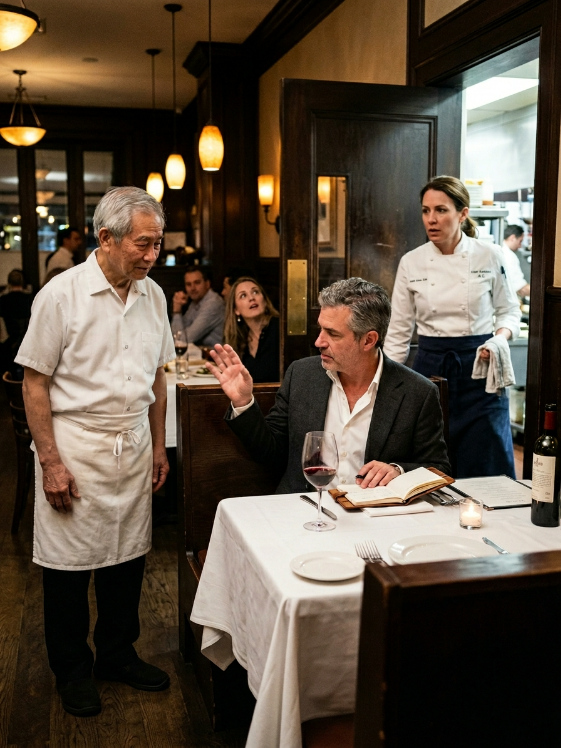
The kitchen door at L’Étable slammed open at 8:47 p.m. on a Saturday in November, and the entire dining room turned at once.
Annie Cole — forty years old, white double-breasted chef coat with her name embroidered across the chest in dark thread, navy waist apron, kitchen towel still gripped in her right hand — came through the door at full pace. She had been on the line. She had a smear of brown butter on her cheekbone that she would not notice until thirty minutes later. She was heading directly for table seven.
The Michelin inspector seated at table seven was, on this particular Saturday, Daniel Ashford, fifty-three, of the New York regional team. Annie did not know that. Annie knew only what her senior server, Maria, had told her thirty seconds earlier in the kitchen: he sat down alone at six-thirty, ordered the tasting menu without asking about pairings, has a leather notebook, has not opened it once, has not photographed a single dish, and he just waved Mr. Tien off when Mr. Tien went to clear his plate.
It was the last sentence that had brought Annie through the door.
Mr. Tien Nguyen — seventy-eight years old, silver hair neatly combed, white short-sleeve busboy jacket buttoned to the collar over black slacks, a white apron tied at the waist, soft canvas shoes — was, at the moment Annie crossed the dining room, three steps back from table seven in a polite half-bow. His worn brass-handled bus tray was on a service stand at the edge of the dining room where he had set it down, gently, the way he set everything down. He had been about to lift the cleared dinner plate. The inspector, without looking up from his leather notebook, had said, “Don’t bother. Send the waiter.”
Mr. Tien had stepped back. He had not said anything.
Annie reached the table at 8:47 and twenty-two seconds. She slowed the last six feet. She placed her hand gently on Mr. Tien’s right shoulder. She kept her voice at the volume of a polite conversation between two people, which meant in a small dining room with twenty-two seated guests, every single person heard her.
“Sir,” she said, to Daniel Ashford, “please. He is the reason this restaurant exists. My grandfather learned to cook from him in Saigon in nineteen seventy-two. He clears plates because he insists on staying useful.”
Daniel Ashford looked up.
He looked at Mr. Tien, in the white busboy jacket, hands at his sides. He looked at Annie, in the chef coat, hand on Mr. Tien’s shoulder. He looked at the brass-handled bus tray on the service stand. He looked back at his leather notebook, which was still closed. He set down his pen, which he had been holding without writing for twenty minutes.
The dining room set down their silverware at the same time.
It was, Annie said later, the quietest restaurant she had ever stood in.
“Madam,” Daniel said. His voice was very even. “May I ask his full name.”
“Mr. Tien Nguyen,” Annie said. “Master Tien, in our kitchen. He came to the United States in nineteen seventy-five. He was the head chef at the Gia Long Hotel in Saigon for twenty-two years before he came. My grandfather, Bao Cole — born Bao Tran — was his apprentice from nineteen seventy-two to nineteen seventy-five, in Saigon. When my grandfather emigrated in seventy-six and opened the first iteration of this restaurant on Mott Street in nineteen eighty-one, Master Tien followed him. My grandfather offered him half the restaurant. Master Tien refused. He has refused for forty-three years. He works two nights a week as a busboy. He says he is too old to run a kitchen and too young to retire from one. The technique on the plate you just had — the lemongrass cure on the duck breast, the fish sauce caramel, the rice — is his.”
Daniel Ashford did not say anything for a count of four.
Then he said, “Madam, if I may. Will Master Tien join me for one moment at this table.”
Annie looked at Mr. Tien. Mr. Tien looked at Annie. He gave the smallest possible nod.
“Yes,” Annie said. “He will.”
Mr. Tien did not sit down. Standing was his preference and at his age it was also his habit. Annie pulled out the chair across from Daniel anyway, and Mr. Tien rested both hands on the back of it. Daniel did not stand. He put both palms flat on the white linen tablecloth, the way you do when you want to make it clear that you are not going anywhere.
“Master Tien,” Daniel said. “I apologize for what I said when you came to clear my plate. I was wrong, I was rude, and I am ashamed. Will you accept the apology.”
Mr. Tien looked at him for a long count.
Then he said, in the soft accent he had spoken English in for fifty years, “Yes. I accept.”
“Thank you. And — sir. Will you tell me, in your own words, what is on the plate I just had.”
Mr. Tien did, slowly, in three short sentences. He had never been a man who said very much. He said the duck cure was his great-grandfather’s recipe from Hue, modified for American duck because American duck was leaner than the duck he had grown up cooking. He said the fish sauce caramel was three generations old and not his. He said the rice was the rice that any cook in Saigon would have made for any guest in nineteen forty-five. Then he stopped.
Daniel Ashford wrote, by hand, in his leather notebook, for two minutes.
Then he closed the notebook. He stood up. He extended his hand across the table to Mr. Tien. Mr. Tien took it. They shook hands once.
“Madam,” Daniel said, to Annie. “I would like to come back next Saturday. Same time. Same table. Will Master Tien clear my plate.”
Annie said, “Yes.”
Daniel nodded, paid for his meal, left a generous tip, and walked out at 9:04 p.m. on the dot. The dining room slowly returned to noise.
He came back the following Saturday. He sat at the same table. He ordered the same tasting menu. Mr. Tien cleared every plate. Daniel did not wave him off this time. He did, at the end of the meal, stand up when Mr. Tien arrived for the last clear, and he bowed, slightly, the way a younger man bows to an older man in any culture in the world. Mr. Tien bowed back. He cleared the plate. He returned to the service stand. He did not say anything. He did not have to.
Three months later, the Michelin Guide announced its New York selections for the year. L’Étable received its first star. The brief citation included an unusual sentence: “The kitchen pays explicit tribute to its origin — the seventy-eight-year-old Vietnamese chef Tien Nguyen, who trained the founder and continues, two nights a week, to clear plates. The respect on the floor is matched by the technique on the plate.”
Annie ordered a new plaque for the front door of the restaurant the same week the citation came out. The old plaque had read: BAO COLE — FOUNDER, NINETEEN EIGHTY-ONE. The new plaque read:
TIEN NGUYEN — TEACHER, NINETEEN SEVENTY-TWO
BAO COLE — FOUNDER, NINETEEN EIGHTY-ONE
Mr. Tien did not say anything when Annie hung the new plaque. He stood in front of it for a moment, very still, in his white busboy jacket and his black slacks, with his apron tied at his waist, and then he picked up his brass-handled bus tray from the service stand and went back to work.