Brian Mathers had a rule about elderly witnesses, and the rule had served him for sixteen years.
Push hard early. Push the distance. Push the lighting. Push the age. Push the medications. Push everything that touches the body and lives in the body. The brain follows the body. Memory follows the brain. Within ten minutes, the brain decides it is not certain enough to fight you, and the deposition swings.
He had used this rule on grandmothers, on grandfathers, on a witness who had seen a hit-and-run in the rain, on a man who had sworn he heard the gunshot before the engine. Brian had broken every one of them by minute eleven. He had Best of the Bar plaques on his bookcase and an office on the twenty-second floor over Centennial Olympic Park.
He had Eleanor Whitman, seventy-two, in his deposition room on a Tuesday morning in October, and he had been preparing for her for three weeks.
She was a key witness in a felony case the firm had taken on retainer for a defendant whose family had, very politely, made it clear that an acquittal would lead to a very large bonus. The witness — Mrs. Whitman, retired — had testified at the original investigation that she had seen the defendant’s white sedan pulled to the curb at a rural Texaco station forty-seven miles from the alleged crime scene at 8:47 p.m. on the night in question. The prosecution had not pursued her testimony. The prosecution, in fact, had stopped returning her calls in February.
Brian had not asked himself why.
He had assumed she was wrong, or vague, or unreliable, or all three. He had assumed the prosecution had done their due diligence and concluded the alibi witness was not credible. He had assumed he would walk in, push her on distance and age, and walk out by lunch.
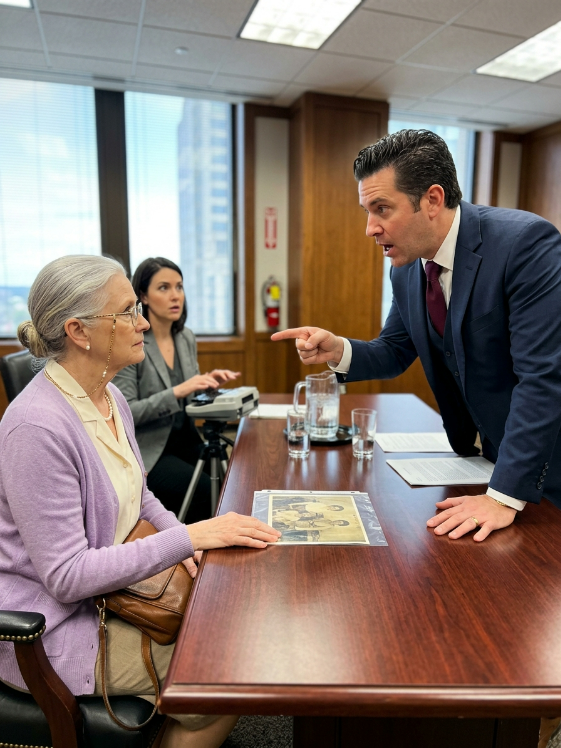
He walked into the polished mahogany deposition room at 10:14 a.m. and saw a small silver-haired woman in a lilac knit cardigan, gold-rimmed glasses on a beaded chain, a single strand of pearls, and a brown leather purse on her lap. The court reporter, who Brian had worked with for nine years, gave him a look he had not seen her give him before — a look that, on a court reporter who had nine years of practice not giving any look at all, said: I would back up if I were you.
Brian did not back up.
He sat down across from Eleanor. He laid his legal pad on the table. He poured himself water. He smiled the smile he had practiced. And he said, after the standard preliminaries, “With respect, Mrs. Whitman — you were two hundred yards away at dusk. Memory at your age is not testimony.”
Eleanor did not blink. She did not put a hand to her chest. She did not look at the court reporter. She looked at Brian for a count of three and said, very evenly, “Counselor, may I ask what your standard is for testimony?”
Brian, who had been in this exact position sixteen years and had heard exactly one variation of every push-back, leaned in. “Direct visual contact. Daylight. Less than a hundred yards. Corroborated by independent evidence.”
“And what is your standard for memory.”
“Recent. Specific. Free of medication-induced cognitive interference.”
“And you took my deposition today on the assumption that I fail one of those standards.”
“With respect, Mrs. Whitman, I took your deposition today because the prosecution declined to call you. There is a reason for that.”
“Yes, Counselor,” Eleanor said. “There is. Would you like me to tell you what it is.”
Brian’s smile, by some involuntary mechanism, came down half an inch.
Eleanor opened the brown leather purse on her lap. She did not rummage. She had practiced this. She withdrew, between two careful fingers, a single worn photograph in a clear plastic sleeve. She placed it face-up on the polished mahogany table between them.
The court reporter’s hands stopped over the stenotype keys.
The photograph showed a 1998 model white Oldsmobile Cutlass, the defendant’s vehicle on the night in question — license plate clearly readable — parked at a rural Texaco station with the price sign visible behind it. The photograph was timestamped on the negative, in the lower right corner: 9/14/22, 8:47 p.m. The bottom edge of the photograph, in small clean handwriting in black ink, read: Witnessed and developed by H. Whitman, owner, Whitman Photography & Surveillance, license #TX-FP-2241.
Brian read it. He read it again.
He looked up at Eleanor.
“My husband’s name was Harold Whitman,” Eleanor said. Her voice was the same voice it had been for the previous three minutes — soft, even, polite. “He passed in March. Before he died, we ran Whitman Photography and Surveillance for fifty-one years. Harold was a certified forensic photographer for the state of Texas, and his timestamps and signatures have been admitted as evidence in over three hundred cases since 1979. I am also a certified forensic photographer. I co-signed our station archives every Sunday for forty years.”
Brian did not speak.
“I told the original investigators in October,” Eleanor continued, “that I had this photograph and seventeen others from the same evening from the same station. The investigator who took my call was a Detective Massey. He said he would forward the photograph to the prosecution. He did not. It sat on his desk for three weeks. When I called to ask, his replacement told me Detective Massey had been reassigned and the file had been re-filed. The re-filing put the photograph in a closed-case archive box for an unrelated property crime in El Paso. I have the chain-of-custody paperwork.”
She placed a second document on the table. Brian did not look at it. He was still looking at the photograph.
“The defendant,” Eleanor said, “was forty-seven miles from the alleged crime scene at the time the prosecution claims he was committing the crime. He could not have been at both places. The photograph, the timestamp, my husband’s signature, and the station’s surveillance log all confirm it. The prosecution received this evidence eighteen months ago. They buried it. I am here, today, in your deposition room, because you and your firm subpoenaed me. I am very glad you did. I have been calling someone, anyone, for eighteen months.”
Brian, for the first time in sixteen years, set down his pen.
“Your client is innocent, Counselor,” Eleanor said. “I would like, very much, for someone in this case to tell him.”
The court reporter, very quietly, kept transcribing.
Brian did not say anything for a count of four. Then he said, “Mrs. Whitman, will you allow me to call my managing partner into the room.”
“Yes.”
He stood up. He walked to the door. He opened it. He turned back, before he stepped through.
“Mrs. Whitman,” he said. “I apologize.”
“It was a long time coming, Counselor,” Eleanor said. “But I accept.”
Two days later, the defendant’s case was dismissed with prejudice on the basis of newly admitted exculpatory evidence. The state opened a misconduct review on the prosecution and on Detective Massey, both of whom were placed on administrative leave within the week. The defendant’s family settled with the state for an amount that was not disclosed publicly.
Brian Mathers did not go for partner that year. He took a six-month leave from the firm. When he came back, he did so as a defense attorney specializing in wrongful conviction appeals, working on contingency for a small storefront practice outside Atlanta where the rent was a tenth of what it had been at his old office. He kept exactly one item on his new office wall: a photograph in a clear plastic sleeve, timestamped 9/14/22, 8:47 p.m., signed in small clean handwriting by a man named Harold Whitman, surveillance photographer, deceased.
He sent Mrs. Whitman a copy of his first acquittal in a thank-you note. The note said only: “He was innocent. You were right.” She did not write back. She did not need to. She had already done her part eighteen months before he showed up.
The photograph stayed on his wall for the rest of his career.