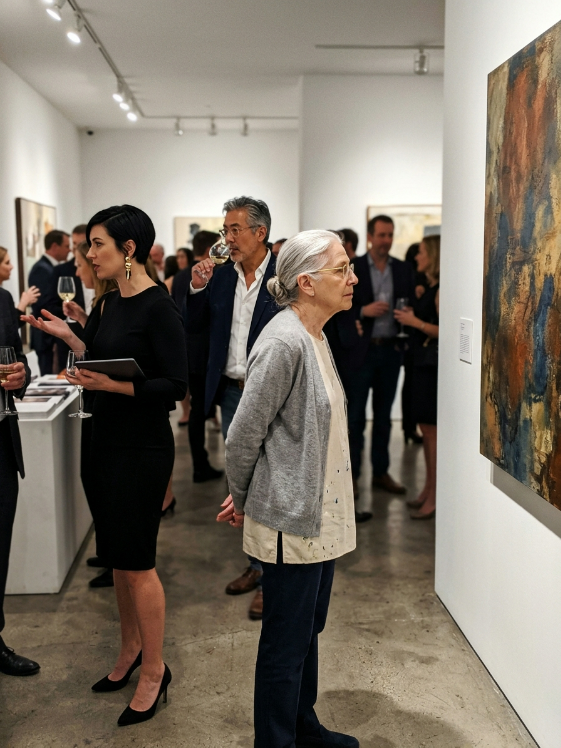
The gallery director told the seventy-six-year-old woman to step back from the painting, and the seventy-six-year-old woman did not step back.
Vanessa Crowe, thirty-five, gallery director of Crowe Contemporary in Chelsea, was already half-turned away when she said it. She had a slim tablet in her left hand and a glass of red wine in her right, and she had been working the room for ninety minutes on opening night for the gallery’s biggest show of the fall. The centerpiece was a 1973 abstract titled Untitled, 1973, on loan from a private collection in Greenwich, insured for nine hundred thousand dollars, hung at the far end of the main wall under three track-light spotlights.
The seventy-six-year-old woman had been studying the painting for six minutes. Soft gray cashmere cardigan over a faintly paint-flecked cream tunic, slim navy slacks, gold half-frame glasses, silver hair in a low bun, hands clasped politely behind her back. She had walked in alone twenty minutes earlier, had not accepted a glass of wine, had not signed the guest book, and had stopped in front of the centerpiece without looking at any of the other works in the show.
Vanessa had finally noticed. The woman was leaning slightly forward. Vanessa’s first thought was that the painting was insured for nine hundred thousand dollars. Her second thought was that the woman did not look like a buyer.
She approached. She pointed her tablet hand toward the catalog desk at the far edge of the floor.
“Ma’am, please don’t lean in. The piece is insured for nine hundred thousand. The catalogue is at the front desk.”
The old woman did not step back. She did not raise her voice. She tilted her head, looked at the small white wall plaque mounted to the right of the painting, and asked, in the quietest possible voice, “Did they finally fix the attribution?”
Vanessa turned the rest of the way back. “I’m sorry?”
“The attribution. On the plaque. Did they fix it.”
Vanessa did not know what the woman was talking about. The plaque had not been changed in the eight months since the painting had been on loan. It read: SAUL ADLER (1944–2009), Untitled, 1973. Oil and enamel on canvas. Loan, private collection. Vanessa had typed it herself in November.
“It says Saul Adler,” Vanessa said, slightly impatient. “Which is correct. Now if you’d like a catalogue —”
“It is not correct,” the old woman said. Her voice had not changed register. “I will wait until you have time to look at it properly. Please do not feel rushed.”
It was at that moment that Dr. Henry Park, sixty-two, senior research curator at the Whitney Museum of American Art, was crossing the gallery floor with a wine glass halfway to his mouth. He had been at the opening only because his wife was on the gallery’s advisory board. He had been about to leave.
He saw the old woman standing in front of the centerpiece.
He stopped mid-step. The wine glass froze in the air. He looked at the old woman. He looked at the painting. He looked at the plaque. Then he set the wine glass down on the tray of a passing waiter and walked very fast toward Vanessa Crowe.
He turned to face the room — twenty or thirty cocktail-dressed guests scattered across the polished concrete floor — and said, in a voice that was loud enough to carry without being loud, “Excuse me. I’d like a moment of your attention, please.”
The room, slowly, gave him their attention. Henry Park did not raise his voice in galleries. When Henry Park raised his voice, it meant something.
“Vanessa,” he said. “This is Ruth Adler. She is the painter of Untitled, 1973. The attribution to her late husband Saul has been formally corrected by Christie’s, the Adler estate, and the Whitney’s research department. The correction was published last December and circulated to every gallery on Christie’s mailing list, including this one. Untitled, 1973 is by Ruth Adler. It has always been by Ruth Adler. The plaque on your wall is wrong.”
The room did not move.
Vanessa, very slowly, looked from Henry to the old woman to the plaque. “There is — there must be a mistake. We have the documentation —”
“You have the loan documentation,” Henry said, gently. “Which still references the work as a Saul Adler because the lender used the original title card from 1973. The provenance was corrected six months ago. Any gallery that did not update the plaque was supposed to be flagged in the December bulletin. Yours was not. Mine was. I am here, in part, on behalf of the Whitney, because we noticed.”
Henry turned to Ruth. “Mrs. Adler. I’m so sorry. I would have called the gallery this afternoon if I had known the plaque had not been updated.”
Ruth — now identifiable to the entire room as Ruth Adler — said, very simply, “It’s all right, Henry. It is not the first time.”
The room had fully understood. A small woman in the back, who had written her thesis on the Adler collaboration in 1989, was already crying. Two of the gallery’s longer-tenured donors were looking at each other in a way that suggested they were going to revise the conversation they had been having for thirty years.
Vanessa, holding her tablet — she had set the wine glass down at some point without remembering doing it — said, very quietly, “Mrs. Adler. I apologize. I will have the plaque replaced tonight.”
Ruth turned to her. She did not smile. She did not look angry. “Replace it tomorrow. Do it during gallery hours. Make a small announcement when you do. Tell people what was wrong on it before. That is what would help most.”
“Yes, ma’am.”
Ruth nodded once. She turned back to the painting and stood there in silence for forty seconds. Then she dropped her hand and turned to walk out. Henry Park walked her to the door. The room, very quietly, gave them the floor.
The plaque was replaced the next afternoon, during gallery hours. The new plaque read: RUTH ADLER (b. 1948), Untitled, 1973. Oil and enamel on canvas. Loan, private collection. Vanessa Crowe gave a short statement to the eleven visitors present and the two reporters from the Times and Hyperallergic she had personally called that morning. The statement was three sentences long.
The Times wrote it up the next day. Three other galleries on the list, who had also not updated their plaques, replaced theirs without being asked.
Untitled, 1973 sold at auction six months later for one-point-six million dollars — almost double its previous sale price — to a private collector who had bid against the Whitney specifically because the Whitney had agreed, in writing, to lend the painting back to Mrs. Adler for the duration of any retrospective she chose to hold during her lifetime.
Ruth Adler held the retrospective at the Whitney in the spring of the following year. It included thirty-one paintings she had made between 1969 and 1986, twenty-eight of which had been credited, until December of the previous year, to her late husband Saul.
She did not hang Untitled, 1973 at the entrance. She hung it at the far end of the gallery’s last room, on a pale gray wall, under a single track-light spotlight, with a very small plaque that simply read:
RUTH ADLER. UNTITLED, 1973.
She stood in front of it on the morning the retrospective opened, at 9:47 a.m., before any visitors had arrived, and looked at it for six minutes. Henry Park stood with her, two steps back, and did not say anything.
When she turned to walk out, she said, very quietly, “It is a small thing. But it is the right thing.”