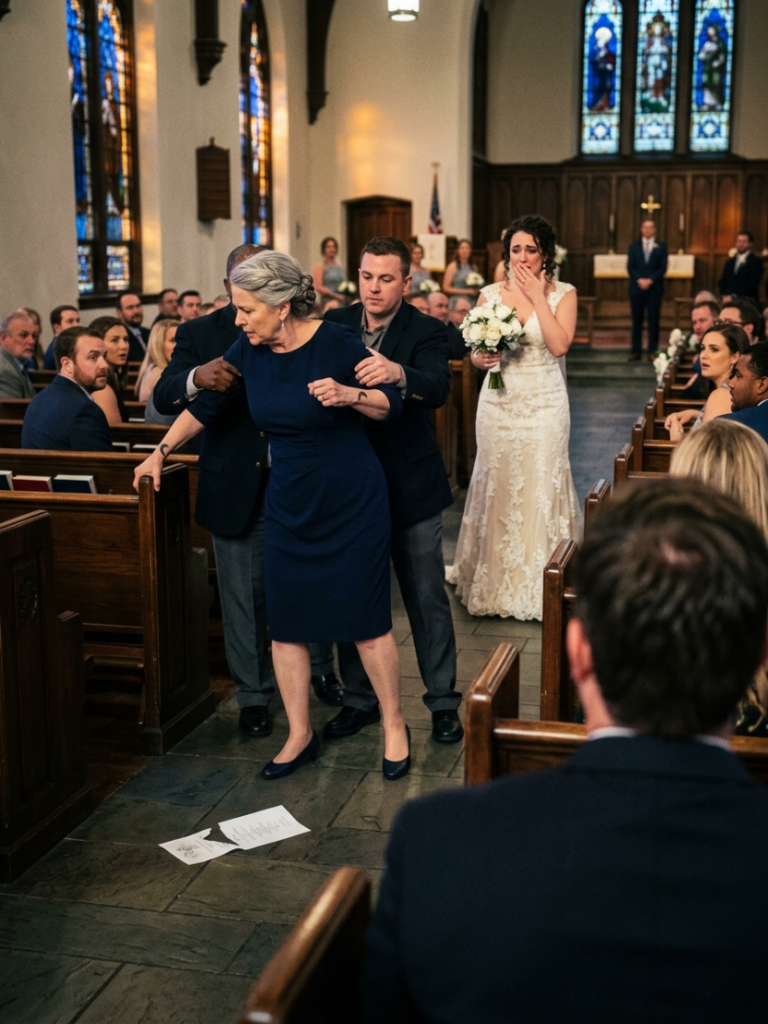
Ava Thornton took one step forward, ivory lace brushing the aisle runner, and the groom’s mother started shouting for security to move faster.
The words hit Grace Chapel like thrown glass. “Remove her now! She isn’t on the guest list! She’s disturbing the ceremony!” Eleanor Whitfield stood near the altar in her pale champagne suit, one manicured hand slicing the air toward the last pew where two security guards in dark blazers had Miriam Cole pinned between them. Miriam, fifty-nine, gray twist pinned low, simple navy dress wrinkled at the elbows from gripping the pew back, did not raise her voice. She let her sleeve stay where it had ridden up, crescent birthmark exposed on her inner wrist like a mark that had waited decades to be seen.
Nobody moved at first. They just watched. Amber light from the stained-glass windows pooled across the wooden pews. Ava had twelve feet left to walk to the altar and could not make her legs remember how. Marcus Whitfield, her groom, stood near the kneeler with his boutonniere crooked, one hand half-raised, face slack with the expression of a man realizing a sound in his memory had just entered the room wearing a body.
Miriam did not look at Eleanor. She looked at Ava with something softer than pleading and harder than apology.
Two hours earlier, Miriam had taken the Greyhound from Brunswick with a folded invitation she had never been mailed. She sat in the back pew because back rows were where women like her had learned to belong without permission. When the organ began and the processional started without her name in any program, she stood anyway. She had not come to steal a wedding. She had come to see whether Dorothy’s granddaughter still carried the family stories, or whether the Whitfields had finally buried everyone who remembered.
Security came first. Then Eleanor’s voice. Then Ava’s step.
“Mom, stop,” Marcus said, but the words came out thin.
Eleanor whipped toward him. “Do not tell me to stop on your wedding day. That woman is—” She cut herself off too late. Guests leaned forward. A torn wedding program lay on the floor between pews where Miriam’s grip had pulled it from a bridesmaid’s hand. Carnations on the cover were smeared with heel marks.
Miriam made a sound then — not a word, not quite a hum. Three notes low and steady, the beginning of a lullaby Ava’s late grandmother used to sing off-key in the kitchen while rolling dough. Ava’s throat closed.
“I know that song,” she whispered.
Eleanor’s face changed color. “Security. Now.”
The guards tightened their grip. Miriam winced once, then steadied, still holding the pew as if it were a railing on a ship. One guard reached for her wrist and his fingers brushed the birthmark. Ava saw it fully for the first time not as a story but as skin: small, crescent-shaped, exactly where grandmother Dorothy had tapped her own wrist at ninety-two and said, My sister Miriam had the moon right there. They sent her away the summer your mother was born. Don’t you ever let anyone tell you she never existed.
“Miriam,” Ava said.
The chapel sucked in a breath.
Marcus’s phone was still in his jacket pocket from rehearsal night. He pulled it out with shaking hands. On the screen was a voice memo dated three weeks ago — Marcus testing microphones in the empty chapel while a cleaning woman hummed in the vestibule. He had kept recording because the melody sounded familiar. He played it now at low volume. The same three notes.
Miriam’s eyes filled. She nodded once.
Eleanor stepped backward into the floral arrangement near the altar. “This is ridiculous. She is a vagrant.”
“She is my aunt,” Ava said, louder. “Dorothy’s sister. The one you told me died in a fire when I was seven.”
Silence opened wide enough to hold everyone in it.
Marcus stared at the phone, then at Miriam, then at his mother. “You told me her records were sealed for privacy.”
“My privacy.” Eleanor’s voice cracked. “Thornton family privacy. If that woman claims blood, the trust revokes on signature.”
The word trust landed like a second ceremony nobody had planned. Dorothy Thornton had left a conditional inheritance tied to undisputed bloodline documentation — wording Eleanor’s attorney had used for twenty years like a lock. Whitfield money had paid for the chapel, the caterer, the security detail. Whitfield influence had kept Miriam Cole’s name off guest lists, off obituaries, off every legal document that might cost them a board seat.
Miriam finally spoke. “I didn’t come for money, Dorothy’s girl. I came because I was dying in a rental in Brunswick and your grandmother’s voice told me not to go until I saw your face.”
Ava walked the rest of the aisle without lifting her bouquet. Security released Miriam as if heat had entered their sleeves. Ava took her aunt’s hands — felt the birthmark under her thumb, warm, real — and smelled bus ticket ink on Miriam’s cuffs.
Eleanor made one last attempt. “Marcus, if you let this—”
Marcus turned to his mother with an expression Ava had never seen on him before. Flat. Finished. “You hired security to remove my wife’s family from her wedding. Play the recording again if you want a witness count.”
He held the phone up. The lullaby looped softly against stone walls. Half the chapel was crying. The organist, forgotten, lowered her hands.
The ceremony did not resume that afternoon. There was no kiss at an altar wrapped in lies. Instead Ava sat with Miriam in the bride’s room and heard the story in pieces: a teenage pregnancy in Savannah, a family name to protect, Miriam sent to live with cousins in South Carolina under a new surname, Dorothy forbidden to write. When Ava’s mother died in childbirth complications, the Whitfields consolidated guardianship paperwork faster than grief allowed. Miriam had searched twice — once after Dorothy’s stroke, once after finding the wedding announcement online — and both times lawyers in gray suits met her at courthouse steps with sealed envelopes and threats dressed as concern.
“Why Cole?” Ava asked.
“Maiden name of the cousin who took me in,” Miriam said. “I kept it so the moon on my wrist wouldn’t be the only true thing about me.”
By evening Eleanor Whitfield left Grace Chapel through the side door without speaking to the photographer. Two board members who had flown in for the wedding canceled their hotel extensions. The caterer still served because hungry people were easier than angry ones, but the head table remained empty until Ava walked out in her gown with Miriam beside her and cut the top tier without a speech.
Three weeks later, in a Savannah attorney’s office with windows facing moss and brick, Ava signed documents that released the Thornton trust from Whitfield control. Marcus signed beside her. Miriam signed as living witness with a hand that trembled only once. Eleanor’s lawyer read the clauses aloud until the room grew tired of his voice.
Miriam moved into the guest apartment above Ava’s garage, not the mansion Eleanor had feared. On the first night she hummed the old lullaby while Ava unpacked wedding china she no longer wanted and put teacups from Miriam’s bus bag into the cabinet instead.
The chapel photo someone took — guards, torn program, crescent wrist — circled local feeds for a day, then faded. What remained was smaller and better: Miriam’s moon mark against Ava’s palm at the kitchen table, steam rising from two cups, Dorothy’s recipe card finally written in a second hand that had come home late but still in time to be called family.