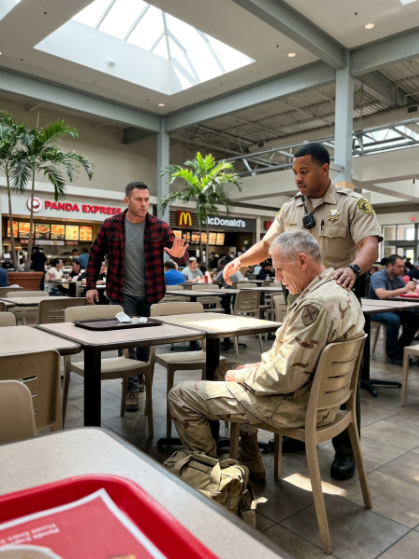
Jake Torres was halfway through a burrito when he made the choice. Not a complicated one — not the kind that requires deliberation or weighing of consequences. The kind that travels from eyes to spine to legs without stopping at the brain for permission. He pushed back the plastic food court chair, left his tray where it sat with hot sauce pooling on foil, and crossed three tables of Riverside Mall food court with the controlled stride of a man whose body remembered training his mind had tried to leave behind.
Three tables away, under the skylight pouring noon California sun like an accidental spotlight, a security guard in khaki had his hand on the shoulder of a sleeping old man in a faded desert camo jacket. “Sir, this isn’t a shelter. I need you to gather your things and exit the premises.” The words were professional. Polite, even. But the hand on the shoulder was firm, and the gesture toward the exit was the kind that assumed compliance.
Frank Kowalski blinked awake. Sixty-nine years old, gaunt face with hollow cheeks, gray crew cut grown slightly past the regulation length he’d maintained for forty years. His worn leather boots — cracked at the soles — shifted on the tile floor as his body oriented from sleep to situation. A small canvas duffel sat on the floor beside his feet, containing everything he owned. No tray. No food. Just a man in a plastic chair catching warmth beneath a skylight because October nights in a parked car leave cold in your joints that midday sun can almost reach.
Jake planted himself between the guard and the old man. Close enough that the guard’s hand had to lift from Frank’s shoulder or make contact with Jake instead. His jaw set like poured concrete. Red-and-black flannel over a gray t-shirt, military-short dark hair buzzed tight at the sides, the kind of bearing that civilian clothes couldn’t fully disguise.
“Do you know who this is?” Jake’s voice was low. Not threatening — controlled. The register of a man who’d learned that volume was never required when certainty was present.
Security Guard Damon Lewis — twenty-eight, three months on the job, khaki uniform shirt still stiff with newness — looked at the man who’d just inserted himself into a routine removal. “Sir, I need to ask you to step—”
“Look at his sleeve.” Jake pointed at Frank’s left arm. The faded desert camouflage jacket — nearly white at the elbows from years of wear — bore a patch on the upper left sleeve. Small, embroidered in muted earth tones, its edges frayed but the image intact: a mountain range above crossed lightning bolts, a number beneath that had been deliberately obscured with black thread but was still visible if you knew where to look.
Damon looked at the patch. Looked at Jake. Didn’t understand.
“That unit insignia,” Jake said, “was authorized for twelve men. Total. In the entire history of the United States military. Eleven of those men are alive because of the man you just woke up.”
Frank’s eyes — alert now, the fog of sleep burned away — moved to Jake’s face. Studied it. And something shifted behind those pale blue irises. Recognition.
“Torres.” Frank’s voice was gravel and rust. “Third squad.”
“Yes, sir.” Jake’s throat worked. “Helmand Province. June 2014. You came through the north wall.”
Damon’s hand had dropped entirely. His radio sat silent on his belt. Around them, the food court continued — families eating, children arguing over fountain drinks, a man mopping near the trash station — all oblivious to the geography of the moment.
Frank straightened in his chair. The movement was slow, joints protesting, but the posture that emerged was unmistakable — the spine of a man who’d carried a hundred pounds of gear through terrain that broke younger bodies. “You were the one bleeding out behind the generator housing.”
“Yes, sir. Femoral nick. Thirty seconds from gone.” Jake’s voice was steady but his eyes were not. “You carried me four hundred meters under fire to the extraction point. Then went back for Hernandez. Then Kowalski went back a third time for the communications officer.”
Frank looked down at his own hands on his thighs — weathered, scarred at the knuckles, trembling slightly from poor nutrition. “That mission never happened, Torres. You know that.”
“I know.” Jake pulled the plastic chair from the neighboring table and sat down across from the old man. Eye level now. “Classified. Never acknowledged. No decoration. No record. Eleven men pulled out of a situation that doesn’t exist on any official document, by a master sergeant who was never officially there.”
Damon had backed up two full steps. His training said remove the sleeping person, but his instincts said this situation exceeded his authority by a margin he couldn’t calculate.
“When did things get—” Jake gestured at the duffel bag, the cracked boots, the gaunt face.
“2017. VA denied the claim because the mission doesn’t exist in their system. No deployment record, no combat verification, no basis for benefits.” Frank almost smiled. The expression was dry, humorless, the kind of smile that acknowledges absurdity without finding it funny. “Can’t get treatment for injuries sustained in an operation that never happened.”
Jake pulled out his phone. Not to call anyone yet — to text. His thumbs moved fast across the screen. One message, sent to a group chat that hadn’t been active in eight months. Six words: Riverside Mall San Diego. Now. Kowalski.
“I’m going to buy you lunch,” Jake said. “And then some people are going to show up. And then we’re going to figure this out.”
Frank looked at the younger man for a long moment. Twenty-six years of service, ten years of silence, three years of sleeping in cars and mall food courts and bus station benches. The weight of being forgotten by a system that classified your sacrifice into nonexistence. “You don’t have to—”
“Master Sergeant.” Jake leaned forward. “You carried me out. You carried out eleven men across three trips in June heat under direct fire. You never received a medal, a pension increase, or a mention in any document. You have been sleeping in mall food courts.” His jaw set again. “That ends today.”
Within forty minutes, the first one arrived. Staff Sergeant Marcus Webb — still active duty, drove from Camp Pendleton in civilian clothes, breaking at least two speed limits. He walked through the food court entrance, spotted the table, and stopped. Then crossed the remaining distance at a pace that matched Jake’s from an hour earlier.
By the time two hours had passed, six men surrounded Frank Kowalski’s table. Six of the eleven who’d been pulled from that compound in Helmand Province in June 2014. They’d come from as far as Oceanside and as close as the parking structure across the street. They stood or sat around the table in a loose perimeter that any veteran would recognize — not quite at attention, not quite at ease, but present. Guarding. Two of them were crying without making a sound.
Frank sat in the center of it with a hamburger going cold on a tray Jake had bought him, and for the first time in three years, he sat in a public space without being asked to leave.
The group chat stayed active. By the following week, a VA attorney specializing in classified service records had taken Frank’s case pro bono — connected through a retired colonel in the group chat who owed his own career to a recommendation Frank wrote in 2009. The denial was overturned in ninety days.
Frank moved into a one-bedroom apartment in National City that December. The lease was co-signed by eleven names. The duffel bag went into a closet. He never slept in a food court again.
On the kitchen wall, in a simple black frame, hung the faded unit patch from his desert camo jacket — twelve lightning bolts for twelve men, the mission that never officially happened, acknowledged now in the only way that mattered: by the men who lived because of it.