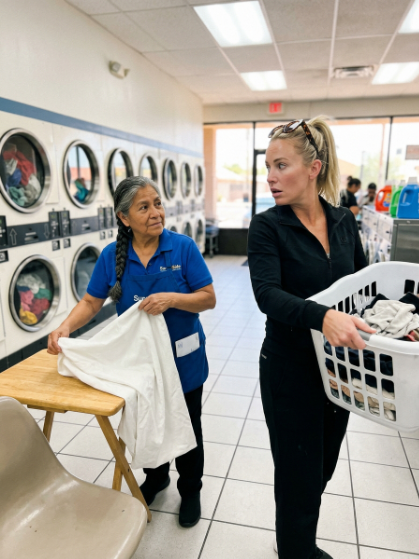
“I’m sorry, ma’am. I’ll stop.” Rosa set down the white sheet and pressed her lips together. The lullaby died in the flat fluorescent light of SunnySide Laundromat like a candle pinched between fingers — there one moment, gone the next. She ducked her head in the quiet way of someone who’d spent decades learning to take up less space when asked.
Claire Whitman was already three steps toward the exit, laundry basket balanced against her hip, designer athleisure catching the overhead glare. Tortoiseshell sunglasses pushed up on her blonde ponytail. A headache that had been building since six in the morning — since the phone call from the attorney about the estate settlement, since the reminder that today was the anniversary, since the knowledge that another year had passed without answers.
Except her feet stopped moving. Her sneakers squeaked on white tile.
Because the silence was wrong. What remained in the air after the singing stopped wasn’t relief from an annoyance — it was the absence of a second verse that only one person in Claire’s entire thirty-six years of life had ever known. A verse her mother used to sing in a voice that sounded nothing like this woman’s voice and yet the melody was identical. Note for note. The phrasing. The pause between the third and fourth line where a breath was supposed to live.
Nobody knew that second verse. Claire’s mother had composed it herself — a nonsense lullaby in a mix of English and made-up words, sung only in Claire’s bedroom, only at night, only between the two of them. It had never been written down. Never recorded. It existed in Claire’s memory and nowhere else in the world.
Until thirty seconds ago, when a stranger in a blue polo had been singing it while folding sheets.
Claire turned back. The laundry basket pressed against her chest like a shield. Her knuckles whitened against its rim. Rosa stood at the folding counter with weathered hands at her sides, gray-streaked braid over one shoulder, looking up with an expression that Claire’s brain refused to categorize as surprise. It wasn’t surprise. It was patience. Deep, practiced, years-long patience — the expression of someone who’d been waiting.
“Where did you learn that song?” Claire’s voice came out barely above the hum of the dryers behind Rosa.
Rosa’s hands folded together in front of her apron. The corner of a white envelope peeked from the front pocket — Claire noticed it without registering it yet. “You recognized it,” Rosa said softly. Not a question.
“The second verse.” Claire’s basket lowered an inch. Her arms were trembling. “Nobody knows the second verse. My mother made it up. She — how do you know my mother’s lullaby?”
Rosa exhaled slowly. She pulled out the plastic molded chair from beside the folding counter and gestured for Claire to sit. Claire didn’t sit. She stood rigid, basket held like armor, while dryers tumbled white fabric in the background and fluorescent tubes hummed their flat, clinical note.
“Your mother’s name was Diane,” Rosa said. “Diane Whitman. Before that — Diane Calloway. You were born in Tucson. She had a birthmark on her left wrist shaped like a small leaf.” Each detail landed like a stone dropped into still water. “She liked cinnamon in her coffee. She read to you from a green book of fairy tales with a torn cover.”
The laundry basket hit the white tile floor. Claire didn’t notice it fall. “Who are you?”
Rosa’s hand moved to her apron pocket. She touched the envelope but didn’t remove it. “My name is Rosa Delgado. I was your mother’s closest friend. From before you were born — we worked together at the hospital in Tucson.” Her eyes held Claire’s with that same impossible patience. “When you were four years old, your mother came to me in the middle of the night. She was terrified. She told me she had to disappear. That people were looking for her — people connected to your father’s family, people she’d testified against — and the only way to keep you safe was to leave you with your grandmother and vanish.”
Claire’s knees buckled. She caught herself on the folding counter. The metal edge dug into her palms. “Witness protection.”
“Yes.” Rosa nodded. “She couldn’t tell you. She couldn’t tell anyone. But the night before she left, she came to my apartment and sang me that lullaby. Both verses. Made me repeat it until I had every note, every pause, every breath in the right place.” Rosa’s voice thickened. “She said someday — maybe years, maybe decades — she would send me a signal. And when she did, I was supposed to sing it. In public. Wherever I was. As many times as it took until you heard it.”
The fluorescent light buzzed. A dryer cycle ended behind them with a loud tone that neither woman registered.
“When?” Claire whispered. “When did she send the signal?”
Rosa pulled the envelope from her apron pocket. White, standard size, no return address. She held it carefully — the way someone holds something that contains both everything and nothing at the same time. “Eight months ago. It was forwarded through three addresses before it reached me. Inside — her handwriting. Six words: ‘Sing until she finds you. Diane.'”
Claire stared at the envelope. “Is she — where is she now?”
Rosa’s face changed. The patience remained but something beneath it gave way — a grief long held in place by purpose, now arriving fully. “The letter was sent by an attorney. Your mother passed away fourteen months ago. She was in Montana. She’d been ill for two years.” Rosa’s voice softened to almost nothing. “She couldn’t contact you directly — not even at the end. The protection order was still active. But she could contact me. And she could ask me to sing.”
Claire’s hand covered her mouth. The sound that escaped wasn’t a sob exactly — more like something structural giving way.
“I’ve been singing in laundromats, grocery stores, parks, and bus stops across Phoenix for eight months,” Rosa said. “Every day. I didn’t know where you lived. I didn’t know what you looked like as an adult. I only knew you were in Arizona — the attorney told me that much.” She looked at Claire with eyes full of decades. “I’ve been asked to stop singing four hundred times. Today was the first time someone turned back.”
Claire lowered herself into the plastic chair. Her legs couldn’t hold her anymore. The laundry basket lay forgotten on the white tile floor, designer athleisure fabric spilling over its rim. She pressed both palms flat on her thighs and breathed.
Rosa sat in the chair beside her. Not touching — just present. The envelope rested on the folding counter between them.
“Can you sing it again?” Claire’s voice was small. “The second verse.”
Rosa sang. Softly, below the hum of the dryers, in the flat fluorescent light of a Wednesday afternoon laundromat in Phoenix, Arizona, she sang a lullaby composed by a dead woman for a daughter she’d spent thirty-two years unable to hold.
Claire closed her eyes and listened. And for the first time since she was four years old, the melody was complete.
She took the envelope home that evening. Inside, beneath the six words in her mother’s handwriting, was a key to a safe deposit box in Billings, Montana. Claire drove there the following weekend. Inside the box: thirty-two years of letters — one for every birthday, one for every Christmas — sealed, stamped, addressed to Claire, and never mailed.
She read them in order, sitting on the floor of the bank’s private room, while Rosa waited in the lobby with two cups of cinnamon coffee.