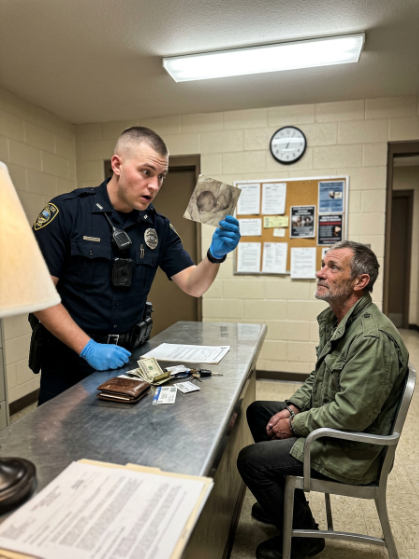
The booking counter at Cedar Falls Police Station smelled like burnt coffee and old metal at eleven o’clock on a Tuesday night. Overhead fluorescents buzzed at a frequency designed to keep nobody comfortable. Officer Ryan Galloway snapped on his latex gloves — standard procedure for personal effects processing — and upended the battered brown leather wallet onto the metal surface.
Contents scattered: three crumpled bills, two dull coins, a worn bus pass with no photo, a folded grocery receipt from six months ago. And a photograph. Creased down the middle, edges soft from years of handling, the kind of wear that comes from being unfolded and refolded a thousand times in dark rooms.
Ryan picked it up. Routine. Just documenting what was there.
His hand stopped.
A newborn. Wrinkled face, hospital blanket, tiny fist curled against a pink cheek. That alone meant nothing — plenty of people carried baby photos. But Ryan’s eyes locked on the left shoulder where the blanket had slipped. A birthmark. Port wine stain, shaped like a crescent, positioned exactly between the shoulder blade and the collarbone. He knew that birthmark. He saw it every morning when his uniform shirt went on.
His fingers began to tremble inside the blue latex. The hospital bracelet on the infant’s wrist — he could make out the date. March 14, 1999. His birthday. And on the back of the photograph, visible through the paper’s wear, handwriting. Not typed, not printed — handwritten in blue ink. He turned it over. The script was faded but legible: Ryan Thomas Galloway, 7 lbs 4 oz. My boy.
He recognized the handwriting. He’d seen it once, on a birthday card his mother kept in her dresser drawer and refused to explain — the single artifact from a father who left when Ryan was six weeks old.
The man sitting across the metal counter didn’t move. Thomas Galloway — fifty-four, weathered face carved by decades of outdoor sleeping, gray stubble grown past the point of intentional style, green army surplus jacket faded at the elbows and collar. His wrists rested in handcuffs in his lap, calm as a man waiting for a bus. His gray eyes watched Ryan without expectation.
Ryan’s mouth opened but nothing came out. The buzzing fluorescent above seemed louder, filling the space where words should have been.
Thomas spoke first. Quietly. With the careful pronunciation of a man who’d rehearsed a name for twenty-six years without ever expecting to say it to the person it belonged to. “Ryan Thomas Galloway. Born March fourteenth at Saint Luke’s. Seven pounds, four ounces. Cried for nine minutes before you settled.”
The photograph trembled in Ryan’s gloved hand. Booking Sergeant Davis — fifty-three, career desk officer, reading glasses pushed up on his forehead — leaned over from the adjacent terminal. His eyes moved from the photo to Ryan’s face to the old man’s face and back again. His chair creaked as he sat back.
“Son,” Davis said carefully. “You need to step away from this booking.”
Ryan didn’t move. His chest rose and fell too fast beneath the navy uniform. His eyes hadn’t left Thomas. “You’re — you were reported abandoned. My mom said you left. Six weeks after I was born. She said—”
“I know what she said.” Thomas’s voice held no anger. Just the weariness of a man carrying a weight so long it had become part of his skeleton. “She said what I asked her to say. What I needed her to say so you’d stop looking.”
“Why?” The word came out cracked.
Thomas’s gray eyes moved to the fluorescent fixture above — that flat, merciless light that hid nothing. “In 1999 I was working for Michael Dunne. You won’t know the name — he’s dead now, federal prison, 2011. But in ’99 he ran half the distribution network between Des Moines and Minneapolis. I was his driver. His mechanic. His accountable one if things went wrong.” He paused. “When you were born, Dunne told me my family was collateral. Insurance for my silence. If I ever talked, if I ever left his operation without permission, he’d visit an address in Cedar Falls.”
Ryan set the photograph down on the metal counter. His latex gloves left a slight smudge on the worn surface.
“I went to the police. Anonymously. Enough to get the investigation started. But it took six years before they had enough for federal charges. Six years where Dunne’s people were watching my family. So I left.” Thomas’s handcuffed hands shifted in his lap. “Walked out one night when you were six weeks old. Told your mother it was the only way to keep you both safe. Told her to say I abandoned you. To make you hate me if she had to. Whatever kept you from looking.”
The station was empty except for the three of them. A clock on the wall ticked audibly. Davis had removed his glasses and was polishing them on his shirt, looking anywhere but at the two men.
“You’ve been here,” Ryan said. “In Cedar Falls.”
“No. But close enough. Waterloo. Des Moines. Sometimes Ames.” Thomas’s eyes came back to Ryan’s face. “I watched you graduate high school. Back of the bleachers. I watched you graduate the academy — stood across the street behind the parking structure. I’ve got three years of photos on a phone I keep charged at the shelter.” His voice thinned. “You look like her. Your mother. Same jaw.”
Ryan pulled off his latex gloves. One, then the other. Set them on the counter beside the photograph and the scattered wallet contents — the three crumpled bills, the coins, the bus pass that constituted the visible total of his father’s life.
“Why tonight? Why get picked up tonight?”
Thomas almost smiled. The expression moved through his weathered face like light through old curtains. “I wasn’t trying to get picked up. I was sleeping at the bus depot because it’s October and the shelters are full. Your patrol partner woke me and I couldn’t produce ID fast enough.” He shrugged — the small gesture of a man long accustomed to being moved along. “But when they said which station, and I realized you might be working tonight — I didn’t fight it.”
Davis cleared his throat. “Ryan. I’m processing him out. No charges — he was just sleeping. I need you to go home.”
Ryan looked at his sergeant. Then back at Thomas. The creased photograph sat between them on cold metal — twenty-six years of distance condensed into a three-by-five image of a newborn with a crescent birthmark.
“I get off at midnight,” Ryan said. “There’s a diner on Main Street. Open all night. The one with the red sign.”
Thomas nodded once. He didn’t smile again. He just nodded, the way a man nods when something he’d stopped believing in becomes true.
At twelve-fifteen, Ryan walked into the diner in civilian clothes. His father was already in a booth by the window, hands wrapped around a coffee he hadn’t ordered — the waitress had just brought it when she saw him sitting alone. Ryan slid into the opposite seat. Neither of them spoke for a full minute.
Then Ryan reached into his jacket pocket and set the creased photograph on the table between their coffee cups. Thomas looked at it. Looked at his son.
“Tell me everything,” Ryan said. “From the beginning.”
Thomas picked up his coffee, took a long sip, and began.