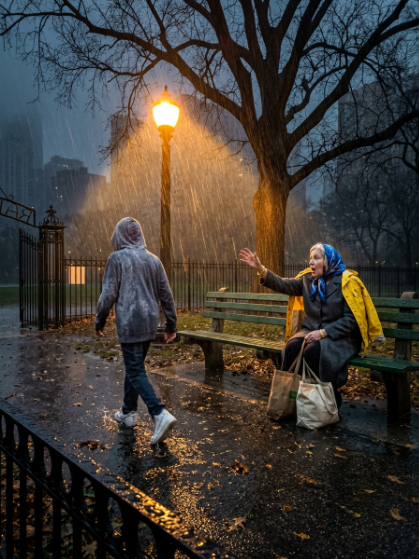
Marcus didn’t turn around. His gray hoodie was soaked through to the skin in under thirty seconds, clinging to shoulder blades that counted too easily through the fabric. Rain hammered his unprotected back in sheets visible as golden streaks through the streetlamp’s sodium cone above Riverside Park’s entrance. He’d made his decision. The old woman was cold and he had a coat and that was the entire calculation. He didn’t need to wait for thanks.
“Young man.” The voice came again. Stronger this time. Pitched to carry through a thunderstorm. Not a request — a command wrapped in courtesy.
He turned slowly, worn white sneakers planted in a puddle that had soaked through to his socks. Three steps away on the weathered green park bench, the old woman sat wearing his torn yellow raincoat draped over her gray wool shoulders. Too small for her. Torn at the collar seam. A child’s coat on a woman who sat like a person accustomed to larger chairs in warmer rooms. Her hand was still raised, gold bracelet catching the orange sodium light.
“Come back here. Please. Sit with me a moment.”
Evelyn Price lowered her hand to her lap. Her posture changed as Marcus watched — straightening on the bench, chin lifting beneath the soaked silk scarf plastered to her silver hair, shoulders settling with a kind of authority that didn’t match a cold woman alone on a park bench with grocery bags getting wet at her feet. Something in the air between them shifted.
Marcus walked back. Not because he trusted her — twelve years in this neighborhood had beaten trust out of encounters with strangers, replaced it with calibration and distance. But something in her voice reminded him of his grandmother before she passed. Certain underneath the softness. Warm, but not weak.
He sat on the far end of the bench. Rain ran down his face in continuous streams. He didn’t wipe it away. Wiping would be admitting it bothered him, and he’d learned not to admit things bothered him.
“What’s your name?” Evelyn asked. The rain fell between them in golden lines through the streetlamp overhead, drumming on the oak’s bare branches like percussion.
“Marcus.”
“Marcus what?”
“Tate.” He watched her from the corner of his eye. She wasn’t shivering anymore. The yellow raincoat — small, torn, undeniably a child’s — covered her shoulders and upper arms like a patchwork shawl. She looked like someone wearing a disguise of vulnerability that didn’t quite fit her.
“Where do you live, Marcus Tate?”
He gestured east with his chin. “Linden Houses. With my aunt.”
“Your parents?”
“Mom works nights. Double shifts at the hospital. No dad.” He said it flat, factual, with no door left open for pity to walk through.
Evelyn nodded. She watched his face for a long moment, and whatever she found there seemed to confirm something she’d already suspected. Then she reached into the pocket of her gray wool coat — beneath his yellow raincoat — and withdrew a small leather card case. From it she produced a cream-colored business card with raised navy lettering. She held it between two fingers, offering it to him like something fragile.
Marcus took it. Rain hit the cardstock immediately but the raised lettering held: Evelyn Price, Executive Director, Lakeside Foundation. Below that, an address on Michigan Avenue. A phone number with a 312 prefix.
“Do you know what the Lakeside Foundation does?” she asked.
He shook his head. The card was getting soft between his fingers.
“We identify young people with character that cannot be taught in a classroom. Courage. Selflessness. The kind of instinct that makes a twelve-year-old boy give his only protection from a storm to a stranger without being asked, without hesitating, and without waiting to be thanked.” She touched the collar of his yellow raincoat on her shoulders. “I’ve been sitting on park benches and at bus stops and in laundromats across this city for three weeks. Fourteen candidates under observation for one annual scholarship. Full tuition — middle school through college. Books. Mentoring. Housing stipend starting at sixteen.”
Marcus stared at the card. A raindrop landed directly on her name and blurred the P in Price.
“I don’t tell you this so you’ll perform for me,” Evelyn said. “The observation is finished. You passed it before you knew it was happening — fifteen minutes ago when you removed your coat, draped it on my shoulders without a single word, and turned to walk into the rain. You didn’t ask my name. You didn’t check if I was important or useful or able to repay you. You just decided an old woman was cold and that you could bear being wet.”
A black sedan pulled to the curb behind the park bench. Headlights cut through the downpour in twin cones. A driver in a dark overcoat stepped out, opened a large umbrella, walked to Evelyn’s side of the bench, and held it over her. His shoes — polished, expensive — didn’t belong anywhere near these puddles, but he didn’t hesitate to stand in one.
Evelyn stood. She did not remove the yellow raincoat. “Can you bring your aunt to my office this week? The address is on the card.”
Marcus stood from the bench. Rain ran down his bare forearms, dripping from his elbows. “My aunt works weekdays. She’s off Thursday.”
“Thursday at ten.” Evelyn nodded. “I’ll have a proper coat waiting for you. But I’m keeping this one.” She touched the torn yellow fabric again. Her voice softened for the first time. “We frame the item that earned each scholarship. It goes in the lobby. Twenty-three years of framed objects — a bus pass, a packed lunch shared with a stranger, a hand-copied homework set given to a classmate. This coat will be next to them.”
The driver extended the umbrella toward Marcus. The boy stepped sideways out of its radius. He was already soaked through. A roof wouldn’t fix that now.
“Why me?” Marcus asked. His voice was steady. Not disbelieving — genuinely curious. “There’s lots of kids who’d give their coat.”
Evelyn looked at him through the rain. “In three weeks of observation, you’re the only one who did. And you did it at six in the evening in a thunderstorm when no one was watching and you had every reason to keep walking.” She paused. “Character isn’t what people do when they’re observed. It’s what they do when they believe they’re alone.”
The driver escorted her to the sedan. She moved under the umbrella with the yellow raincoat still over her shoulders, grocery bags carried by the driver in his free hand. The rear door opened and closed. Taillights glowed red through the rain, blurred, then disappeared around the curve of Riverside Drive.
Marcus stood under the streetlamp with the business card growing soft between his fingers. He read it one more time — the address, the name, the foundation — then slid it carefully into his hoodie’s interior pocket, the one closest to his chest where water hadn’t reached yet.
He walked home. Three miles east through the storm, gray hoodie heavy as chain mail with water, sneakers squelching on every step. He didn’t tell his aunt until after he’d changed clothes and heated up the leftover rice she’d left on the stove.
The following Thursday at ten in the morning, a torn yellow raincoat was mounted in a glass frame in the Lakeside Foundation lobby on Michigan Avenue. Beneath it, a small brass plate: Marcus Tate, Annual Scholar. Awarded for character given freely in a storm.
Marcus touched the glass once, briefly, then followed Evelyn Price into the office where his future was waiting in a manila folder.