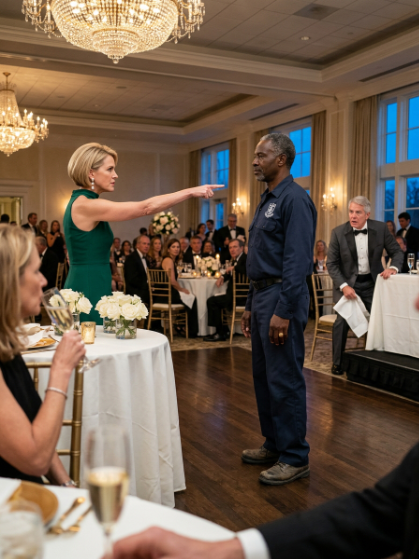
Catherine Hale had organized twelve donor dinners in her tenure as headmistress, and she had never once been wrong about who belonged beneath those crystal chandeliers. The ballroom at Whitmore Academy was her domain — white linen tables, gold-rimmed chargers, champagne at seventy dollars a bottle, and one hundred and twenty of the most generous benefactors in Greenwich society arranged by her seating chart. Every face accounted for. Every name on a list she’d approved personally.
The janitor was not on her list.
Her arm extended toward the side exit, pearl earrings swaying with the force of the gesture, emerald gown catching chandelier light. “I won’t ask a third time. This event is for donors only. You have absolutely no business here tonight.” Her voice carried across tables. Heads turned. Champagne flutes paused between linen and lips.
Robert Mwangi stood motionless in his navy janitorial uniform. The fabric was pressed sharp enough to cut. Work boots polished to a mirror finish — worn at the soles but gleaming on top. His shoulders remained square. His chin stayed level. The gold signet ring on his right hand caught a fractured spike of chandelier light, and the crest engraved in its face was identical — line for line, curve for curve — to the crest embossed on every scholarship plaque lining the hallway Catherine walked each morning without ever pausing to examine.
He met her eyes. Said nothing. Not because he couldn’t speak but because he was still gathering data.
At the head table, Board Chairman David Ashworth dropped his napkin. Both hands pressed flat against white linen. His silver hair caught the warm overhead glow as he rose from his chair with deliberate slowness — the pace of a man who understood that every person in this room was watching, and that what happened next would be remembered for decades.
He crossed the ballroom floor. His charcoal tuxedo moved without a wrinkle. He stopped in front of Robert, extended his right hand, and bowed his head — the slight, formal inclination of a man greeting someone whose station exceeds his own.
“Ladies and gentlemen.” David’s voice carried without amplification, filling the ballroom the way a church bell fills a valley. Conversations died mid-syllable. Forks settled onto porcelain. “I’d like you to meet our keynote benefactor.”
The silence lasted five seconds. Then the murmuring started — a wave of confusion rolling from table to table, growing louder, layered with the sound of chairs shifting as people tried to see better.
Catherine’s arm lowered to her side. The emerald silk of her sleeve brushed against her hip. Her face moved through expressions too quickly for any single one to settle: confusion, denial, the first cold recognition that she’d made an error so public it might define her career.
“I don’t understand.” Her voice had lost its command. “The Whitmore Foundation donor is anonymous. No one knows—”
“I know.” David released Robert’s hand and turned to face the room. “The Whitmore Foundation has funded every scholarship this academy has awarded for twenty consecutive years. Three hundred and twelve students. Total contribution: eleven point eight million dollars. The single condition of continued funding was anonymity.” He paused to let the number settle into a hundred and twenty brains performing rapid calculations. “Tonight was supposed to be the evening we asked our benefactor to renew that endowment for another decade.”
Robert adjusted the cuff of his janitorial uniform. The signet ring — eighteen-karat gold, handed down from his grandfather, Whitmore class of 1942, the first Black student admitted to this academy — rotated slightly on his finger as he straightened the fabric. The academy crest caught the light once more.
“I graduated from this school in 1984,” Robert said. His voice was deep and unhurried, carrying the natural resonance of a man who chose his words with precision because each one mattered. “Full scholarship student. I worked in the kitchen to cover my books. I ate meals after the other students finished because I was embarrassed about my uniform.” He let that sit. Several donors at the nearest table set down their flutes with audible clicks against the linen. “I know what it feels like to walk these hallways and be told — in words or in silence — that you don’t belong here.”
Catherine opened her mouth. Nothing came.
“Six months ago,” Robert continued, “I applied for the janitorial position under a different surname. I wanted to see — before I committed twelve million dollars for another ten years — whether this school had changed. Whether a man in a work uniform would be treated with the same respect as a man in a tuxedo.”
The chandelier above hummed in the silence. Crystal prisms threw fractured rainbows across white linen that nobody was looking at.
“In six months,” he said, “I have been addressed by name exactly twice. Both times by students. Never by a single faculty member. Never by administration.” His eyes moved to Catherine. “I’ve been asked to leave three faculty events. I’ve eaten lunch alone in the maintenance room because the staff cafeteria table by the window is informally reserved for department heads — and everyone enforces it without a word being spoken.” He paused. “Tonight was the final observation.”
David Ashworth placed his hand on Robert’s shoulder — a gesture of solidarity visible to every table in the room. “The endowment renewal under discussion is twelve million dollars.”
Robert reached into the breast pocket of his uniform — the one with the small embroidered academy crest, the same crest as his ring, the same crest as the plaques in the hallway — and withdrew a folded envelope. Cream stationery. He placed it on the nearest table between a gold-rimmed charger and an untouched champagne flute.
Catherine didn’t move toward it. Her feet had rooted themselves to the ballroom floor.
David picked it up. Unfolded the single page inside. Read two lines. His face shifted into a slow, knowing smile.
“The endowment is renewed,” David read aloud, his voice reaching every corner of the ballroom, “on the condition that Whitmore Academy implements mandatory service rotations for all administrative and faculty staff — including the headmistress — in custodial, kitchen, and groundskeeping roles. One full week per academic year. Beginning this semester.”
Robert buttoned the top button of his uniform jacket. The signet ring caught the chandelier light one final time — one clean flash — as his hand settled at his side. “I’ll attend graduation in June. In different clothes. But I expect to find Headmistress Hale in the kitchen during service rotation week. Learning the dishwasher’s name. Eating lunch at his table.”
He turned and walked out through the main entrance — the tall double doors reserved for donors, not the service exit Catherine had pointed toward. His polished work boots made no sound on the marble floor. The doors closed softly behind him.
David Ashworth began to applaud. One table joined — hesitant. Then the next. Then the entire room, rising to their feet in a wave of standing ovation for a man who’d already left the building.
Catherine Hale stood alone in her emerald gown, pearl earrings motionless now, arm still at her side where she’d lowered it minutes ago. The applause moved around her like water around a stone.
The envelope remained on the table for the rest of the evening. Twelve million dollars, on one condition, folded once.