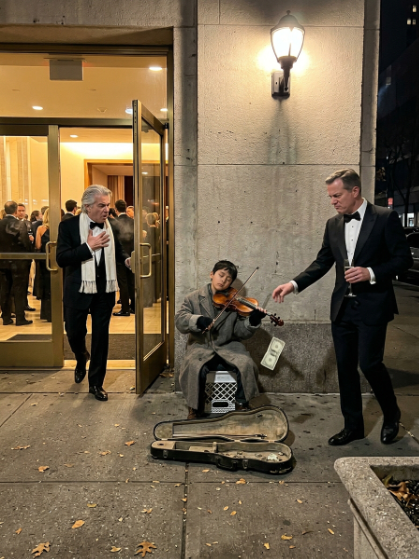
Nobody in the small crowd outside Lincoln Center moved to stop Harrison Webb. His black tuxedo cost more than most of them earned in a month, and the champagne fizzing in his crystal flute gave him the confidence of a man who believed money granted authority over public sidewalks. The crumpled dollar bill he’d tossed floated past the open violin case, caught a breeze, and landed in the gutter. Mateo didn’t notice. His eyes stayed closed, bow moving steadily across the violin’s single remaining string, fingerless gloves gripping the wood with practiced certainty.
Conductor Adrian Volkov stood on the threshold of Lincoln Center’s side entrance, one polished shoe still on carpet and one on cold concrete. His white silk scarf caught the gold light spilling from behind him. His right hand pressed against his sternum as if something behind his ribs had cracked clean through.
Thirty years. He’d spent thirty years mourning a composition that was supposed to have burned in the 1994 studio fire at the Moscow Conservatory — his mentor Dimitri Kuznetsov’s final work. Never recorded. Never published. Existing only in the memory of those who’d been present for its single private playing, one evening in March before the electrical fire consumed every manuscript in Dimitri’s office.
And here it was. Rising whole and unmistakable from one string on a damaged violin, played by a nine-year-old on a milk crate beneath a street lamp.
Volkov stepped fully onto the sidewalk. The autumn cold hit his face — he didn’t register it. He walked past Harrison without acknowledgment, past the small audience of gala-goers who’d stopped to watch, past the crumpled dollar bill in the gutter. He approached the milk crate and knelt on the concrete. Both knees. Dress pants pressed into cold, dirty sidewalk.
Mateo’s eyes opened. The bow stopped mid-stroke. A thin boy in an oversized gray coat staring at a kneeling man in a formal suit — both frozen in the cone of streetlamp light while leaves scattered around them and gold light from the doors painted their silhouettes against stone.
“Where did you learn that piece?” Volkov’s voice was barely controlled. His accent — Russian, worn smooth by decades in New York — thickened the way it only did when emotion overwhelmed discipline.
Mateo pulled the violin closer to his chest. The instinct of a child who’d learned that things you love can be taken. “My grandpa taught me. He plays it every night before bed.”
Volkov’s knuckles pressed against his lips. “Your grandfather. What is his name?”
“Alejandro Reyes.” The boy watched the man’s composure crack. “He lives with us in Washington Heights. He’s sick now — can’t get out of bed — but he still plays. His violin only has one string too. We share a pack between us.”
Volkov sat back on his heels. Behind him, the gala continued — orchestra tuning, laughter and clinking glass, the glittering world of classical music twenty feet away, oblivious to a miracle on the sidewalk.
Alejandro Reyes. The youngest student in Dimitri’s studio. The quietest. The one from Mexico City who memorized everything because he couldn’t afford manuscript paper. Volkov remembered him — nineteen, thin, always in the back corner, eyes closed while Dimitri played, absorbing every note like soil absorbing rain.
“That composition,” Volkov said carefully, “was written by a man named Dimitri Kuznetsov. He was my teacher. He died in 1994. Your grandfather was his student — the same studio, the same years.”
Mateo’s bow lowered to his lap. “Grandpa never told me a name. He just said it was the most important song he’d ever heard. Made me learn every note. All six minutes. Said somebody had to carry it.”
Harrison Webb stepped closer, patent leather shoes entering the lamplight. Champagne flute still in hand, posture announcing his intention to assert control. “Is there a problem here? The boy is clearly—”
“Be quiet.” Volkov didn’t turn his head. The words carried the authority of a man who silenced three hundred musicians with a finger’s movement. Harrison’s mouth closed. He stepped back as if physically pushed.
Volkov stood, knees aching from concrete. He unwound the white silk scarf from his neck and draped it around Mateo’s thin shoulders. The boy flinched, then held still as warmth settled.
“I want to meet your grandfather tonight. Can you take me to him?”
Mateo studied the conductor’s face. Whatever calculus a street-smart nine-year-old runs — checking for danger, measuring sincerity against experience — completed itself behind those brown eyes. He nodded. Placed the violin carefully in its battered case, closed the lid, tucked the scarf tighter, and stood.
A black town car idled at the curb — Volkov’s driver. The conductor opened the rear door himself. “Sit wherever you’d like. We’re going to Washington Heights.”
Fourteen minutes through Friday traffic. A walkup — fourth floor, no elevator, institutional green walls. Mateo’s mother opened 4C in hospital scrubs, confusion turning to alarm at the suited man behind her son. Mateo explained in rapid Spanish. Her face shifted from suspicion to cautious allowance.
In the bedroom, Alejandro Reyes — eighty-one, bedridden, oxygen concentrator humming — opened clouded eyes to see a face from 1993.
“Adrian.” His voice was thread-thin. But he smiled. “You got old.”
Volkov knelt beside the bed. Took the papery hand. “You memorized it. The entire Kuznetsov composition.”
“Night before the fire.” Alejandro’s chest rose with effort. “I played it through in my head seventeen times because I couldn’t sleep. Next morning — all gone. But I had it here.” He tapped his temple with one thin finger. “Tried to write it down after my stroke, but my hands don’t obey. So I taught the boy. One string at a time.”
Volkov made two calls from the hallway. The first to his assistant at the conservatory: full preparatory scholarship, immediate enrollment, instrument provided. The second to a violin luthier: two instruments restored, delivered Tuesday.
The following week, a recording team arrived at 4C with a string quartet and three microphones. Alejandro dictated the composition bar by bar from his bed while the quartet played each section for confirmation. Nine hours across two days. He fell asleep twice, waking each time to correct a note the cellist had flatted.
The recording premiered at Lincoln Center four months later — Kuznetsov’s Composition No. 7, preserved by Alejandro Reyes. Mateo sat in the front row in a coat that fit, new violin case at his feet. His grandfather watched from home on a tablet propped against his pillow, oxygen concentrator humming accompaniment.
In the margin of his program, Mateo drew a small violin with one string, studied it a moment, then added three more.