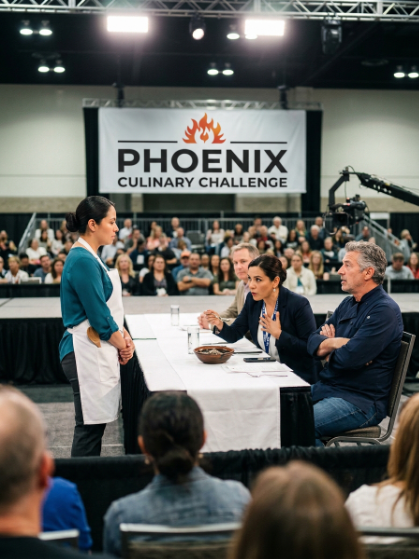
The room went wrong on the live broadcast at exactly two-fourteen on a Saturday afternoon in October.
It went wrong quietly. No one in the banked seating of the Phoenix Convention Center’s main competition hall heard it happen — not the two hundred audience members, not the cameraman on the jib, not the production assistant behind the curtain. It went wrong in the space between one judge’s spoon touching a table and another judge’s hand rising to her chest.
Lucia Mendez stood on the cook’s side of the tasting station. She was thirty-eight years old, dark hair pulled back into a smooth low bun, simple white kitchen apron over a teal blouse, dark slacks, brown leather flats, small silver hoop earrings. In the front pocket of her apron, tucked upright like a pen, was her grandmother’s small wooden cooking spoon — hand-carved mesquite, dark with forty years of oil and use, too small for actual stirring but kept close because her grandmother had held it every time she taught Lucia anything.
On the white linen runner between the three judges sat a small earthenware bowl of mole negro. Dark, almost black, with a faint sheen of oils on the surface, garnished with toasted sesame seeds. Forty-three ingredients. Twelve hours of preparation. A recipe that lived in no cookbook and had been passed from Lucia’s grandmother to her mother to her in a kitchen with no measuring cups.
Lead judge Vincent Marquand had just tasted it. He was fifty-seven, salt-and-pepper hair combed back, navy double-breasted chef coat with embroidered credentials, blue jeans, polished black shoes. He put his tasting spoon down with the deliberate authority of a man who had been on television for fifteen years.
“It’s — well, it’s a stew,” Vincent said into the broadcast camera. He leaned back and crossed his arms. “Unsophisticated. Provincial. I taste no technique. I taste ingredients that have been heated together without refinement. The presentation is — ” He gestured at the earthenware bowl. “Rustic.”
Lucia did not move. Her hands were folded at her waist. Her face did not change. She had been cooking this dish since she was eleven years old. She had made it for her grandmother’s funeral. She had not made it to impress a man in a chef coat.
To Vincent’s left, the second judge had not put down her spoon.
Dr. Rosa Delgado was forty-eight, dark hair in a low neat chignon, navy blazer over a white blouse, a James Beard Foundation lanyard at her chest, simple gold studs. She was a culinary historian — half-Mexican-American, raised in Tucson, PhD from the University of Texas, author of three books on indigenous Mesoamerican food traditions. She had been quiet for most of the afternoon, giving polite measured commentary on eight dishes.
She was not being polite now. She was holding her tasting spoon above the bowl and looking at the mole negro with an expression that the camera operator would later describe as “like she’d seen a ghost.”
She took a second taste. Then a third. Her free left hand went, very slowly, to her chest.
“Vincent,” Rosa said. Her voice cut cleanly across his. “May I taste it once more before you continue.”
Vincent blinked. In fifteen years of broadcast judging, no one had interrupted his commentary. “By all means.”
Rosa took a fourth taste. She closed her eyes. She held the mole on her tongue for a count of three. She opened her eyes. She set the spoon down with deliberate care and looked across the tasting station at Lucia.
“Where did you learn this,” Rosa said. “Specifically. Which village.”
The audience murmured. The camera on the jib swung toward Lucia.
Lucia looked at Rosa — at the expression on her face, which was not that of a judge evaluating a contestant but of someone who has just been handed something they thought was lost.
“My grandmother,” Lucia said. “Abuela Soledad. She was from a small village outside Oaxaca. Zapotec. San Pablo Huixtepec, but the recipe comes from a valley settlement above it that has no name on most maps.”
Rosa’s hand was still at her chest.
“The chile,” Rosa said. “The mountain chile. Which valley.”
This was not a question Lucia had ever been asked before. Not by anyone outside her family. Not by anyone who was not from the same twelve-mile stretch of Oaxacan highlands where her grandmother had spent the first forty years of her life.
“Valle de las Tres Cruces,” Lucia said. “The chile grows only there. It has no commercial name. My grandmother called it chile de cerro. There is a woman in the village who still grows it. She ships it to me once a year in a coffee can.”
Rosa looked at Vincent. “Vincent,” she said. “This is not a stew.” Her voice was even but carried the weight of twenty years in archives and kitchens and fieldwork. “This is a forty-three-ingredient regional mole negro from a Zapotec village in the Sierra Sur. The preparation technique is pre-colonial. The mountain chile she is using grows in three valleys on earth. I spent six months researching this exact preparation for a James Beard Foundation regional-heritage report in two thousand three. I could not find a living practitioner.” She looked at Lucia. “I could not find anyone who still made it.”
The hall was silent.
“This dish is not unsophisticated. It is one of the most technically demanding preparations in the indigenous Mexican culinary tradition. The fact that it does not look like technique to you is a commentary on your frame of reference, not on her cooking.”
Vincent’s arms were no longer crossed. He did not speak.
Rosa turned back to Lucia. “Your grandmother. Is she still alive?”
“No,” Lucia said. “She passed in two thousand nineteen.”
Rosa nodded. She was quiet for a moment.
“I would like,” Rosa said, “to award this dish the maximum score. I would also like to note for the broadcast record that this contestant has presented a regional heritage preparation that the James Beard Foundation has been unable to document from a living source for over twenty years.”
The third judge raised her scoring paddle. Perfect marks. Rosa raised hers. Vincent, after a long pause, set his paddle face-down and said, “I recuse myself on grounds of additional context required.”
Lucia won the Southwest Regional Championship by unanimous eligible vote. She did not cry on camera. She did, very quietly, reach into her apron pocket and close her hand around her grandmother’s wooden spoon.
Three months later, Rosa flew Lucia to New York for the James Beard Foundation’s annual awards ceremony. Lucia sat at a table in a ballroom she had never imagined entering, her grandmother’s spoon in her jacket pocket, and watched Rosa present the Regional Heritage Honoree award to “Lucia Mendez, keeper of a recipe that almost disappeared from the earth.”
Lucia walked to the stage. She said, into the microphone, “My grandmother could not read. She never left Mexico. She taught me this recipe by putting my hands in the bowl and saying ‘feel when it is ready.’ She was the most sophisticated cook I will ever know.”
She did not mention Vincent Marquand. He was in the audience. He did not clap. He did, three weeks later, send a handwritten note to the James Beard office that read: “I was wrong. Please tell her.”
Rosa told her. Lucia read the note, folded it once, put it in the same pocket as the wooden spoon, and went back to her kitchen.