Friday’s retirement reception was canceled at three-forty-five on Thursday afternoon.
Greg Manning said it in one sentence, standing behind his desk in a light gray suit with a light-blue tie and a school-logo lapel pin he had received on his first day six weeks ago. He said it to Mrs. Loretta Banks, the school secretary, who had worked at Akron Central High School for thirty-one years and who had, that morning, ordered a sheet cake from the bakery on West Market Street. “We don’t have budget for catering for non-instructional staff,” Greg said. “He’ll get a card. I’ll sign it tonight.”
He went back to his email. Mrs. Banks, standing in the doorway with an order form in her hand, went very still. She did not say anything. She turned, walked to her desk, picked up the phone, and called the school board office.
The man whose reception had just been canceled was Wendell Carter. He was sixty-four years old. He had been the head custodian at Akron Central for twenty-two years. He had mopped the gymnasium floor after every home game since 2002. He had fixed the third-floor boys’ bathroom faucet nine times because the district would not approve a replacement. He had never, in twenty-two years, called in sick on a day when students were in the building.
Wendell did not know his reception had been canceled. He was, at three-forty-five on Thursday afternoon, replacing a fluorescent tube in the science wing hallway, whistling something his wife used to sing before she passed in 2019.
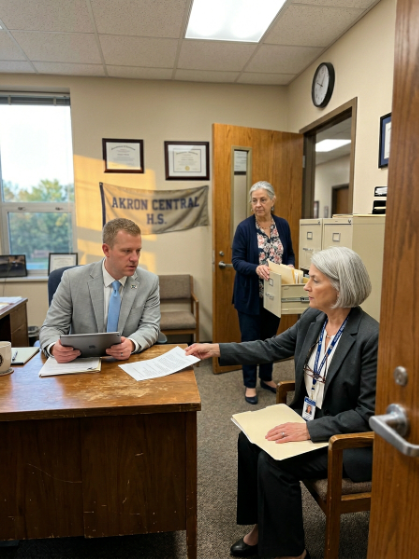
At four-oh-two, school-board chair Dr. Eleanor Pace walked into the main office unannounced. She was sixty-two, silver hair in a low neat bob, charcoal blazer over a white blouse, school-board lanyard with a photo badge, reading glasses on a thin chain at her chest. She had a manila folder under her arm. She had heard about the cancellation from Mrs. Banks within fifteen minutes.
She walked past Mrs. Banks’s desk without stopping. She walked into Greg’s office. She closed the door. She sat down in the visitor chair without being asked. Late-afternoon golden light fell through the one window onto Greg’s desk.
Greg looked up from his tablet. “Dr. Pace. I didn’t have you on the—”
“Mr. Manning.” Eleanor set the manila folder on her lap. “The man whose retirement reception you just canceled. Tell me what you know about him.”
Greg blinked. “Wendell Carter. Head custodian. Twenty-two years. Retiring Friday. We’re giving him a card and a—”
“What else.”
Greg paused. He did not have anything else.
Eleanor opened the manila folder. She slid a single typed sheet across the desk between them. Greg leaned forward, tablet still in his left hand, and looked down at the paper.
It was a list of fourteen names.
“Mr. Manning,” Eleanor said. “The names on this list are fourteen students — former students — of Akron Central High School, class years two thousand four through two thousand twenty-three. Every name on this list is a student whose graduation fees, prom ticket, senior portrait sitting, or cap-and-gown rental was quietly paid for, in cash, by Mr. Wendell Carter. Out of his own salary. Which has never exceeded thirty-four thousand dollars in any year of his employment.”
Greg looked at the list. He did not speak.
“We do not announce this,” Eleanor continued. “Mr. Carter has never told anyone. The school board found out by accident in two thousand seventeen, when a parent called to thank us for the ‘scholarship’ that had covered her son’s graduation fees. We had no such scholarship. We traced the payment to an envelope of cash left with the registrar’s office. The registrar told us it had been Wendell.”
She adjusted her reading glasses.
“Since two thousand seventeen, we have tracked it quietly. Fourteen students. Roughly eighteen hundred dollars per year. Out of a thirty-four-thousand-dollar salary. Mr. Carter has never been reimbursed. He has never asked. He has, on three occasions, specifically requested that the school board not acknowledge what he does. He said — and I am quoting — ‘Those kids don’t need to know it came from the janitor. They just need to walk across the stage.’”
Greg set his tablet down on the desk.
“Dr. Pace,” he said. “I didn’t—”
“No,” Eleanor said. “You didn’t.” She closed the folder. “Mr. Manning, I understand you are six weeks into this position. I understand budget review is part of your mandate. But I want you to know three things. First: there has been a dedicated budget line for Mr. Carter’s retirement reception since two thousand eighteen. It is in your district allocation file under ‘staff recognition — custodial.’ You did not find it because you did not look for it.”
Greg’s mouth opened, then closed.
“Second: the student body president of the class of two thousand twenty-two — a young man named Devon Marshall, one of the fourteen names on that list — is currently a freshman at Ohio State on a full academic scholarship. He has been driving back to Akron since four o’clock this afternoon. He will be at the reception tomorrow. He is driving four hours because Wendell Carter paid his fifty-dollar senior portrait fee and Devon did not find out until last Christmas.”
Eleanor stood.
“Third: Friday’s reception is uncanceled. The cake is ordered. The gymnasium will be decorated by the student council tonight. You are expected to attend. And Mr. Manning — ” She looked at him. “If you would like to contribute personally, the budget line accepts staff donations.”
She picked up her folder. She walked to the door. She paused.
“One more thing. The sheet cake from West Market is forty-two dollars. Mrs. Banks ordered it this morning on her personal credit card. She has been doing that every year for eight years because the budget line is only two hundred and the reception always costs more.”
She opened the door. Mrs. Banks was standing at the filing cabinet just outside, watching.
“Loretta,” Eleanor said. “The reception is on. Full gymnasium. Friday at three.”
Mrs. Banks nodded once. She did not look at Greg.
Eleanor left. The office was very quiet.
Greg sat behind his desk for seven minutes. Then he pulled open his drawer, took out his personal checkbook, and wrote a check for five hundred dollars to the Akron Central Staff Recognition Fund. He left it on Mrs. Banks’s desk on his way out without saying anything.
On Friday at three o’clock, the gymnasium was full. Two hundred and fourteen people. Students, staff, parents, alumni. Devon Marshall, nineteen years old, drove in from Columbus in a borrowed Honda Civic and stood at the back in an Ohio State sweatshirt until Wendell Carter walked in and saw him and stopped.
“Boy,” Wendell said. “You drove four hours for this?”
“Yes sir,” Devon said. “You paid fifty dollars for my portrait so my mama wouldn’t have to choose between groceries and my picture on her wall. I can drive four hours.”
Wendell Carter did not cry. He did, very quietly, put one hand on Devon’s shoulder and squeeze once.
Greg Manning stood at the back of the gymnasium for the entire reception. He shook Wendell’s hand at the end. Wendell shook it back and said, “Thank you for coming, Mr. Manning,” without irony, without accusation, without anything but the same quiet grace he had carried through twenty-two years of fluorescent tubes and mopped floors and fifty-dollar envelopes left at the registrar’s desk.
Greg nodded. He went home. He did not cancel another reception for the rest of his tenure.