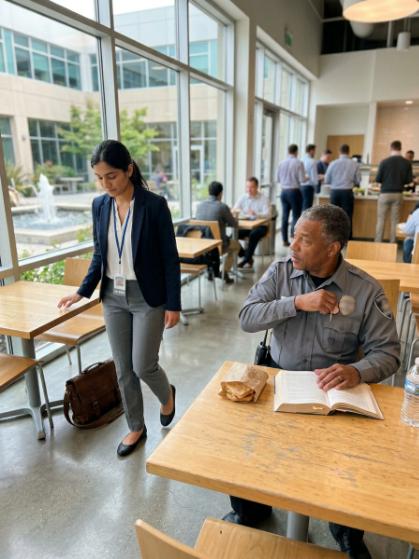
She was sorry before she even sat down.
Priya Shah had been apologizing since the moment she walked through the glass doors of Innova Systems three weeks ago — to the elevator for pressing the wrong floor, to the receptionist for asking where the bathroom was, to her own reflection in the lobby mirror for existing in a building where the entry-level salaries were four times her internship stipend. She was twenty-two years old, dark hair pulled into a low ponytail, navy interview blazer over a white blouse she had ironed that morning on the hotel ironing board. Her lanyard said INTERN in block letters. Her messenger bag was held together at one strap with electrical tape.
At twelve-fourteen on a Tuesday in October, she sat alone at a two-top near the floor-to-ceiling windows of the main cafeteria and unwrapped a peanut-butter sandwich she had made in her shared apartment that morning. She had made two. She always made two, because hunger hit again at three and the vending machines here cost four dollars for a granola bar.
At the next table, a man in a gray security-guard uniform sat alone with a dog-eared paperback open in front of him. Salt-and-pepper hair, short and tousled. Scuffed black work boots. A holstered handheld radio at his belt that had not crackled once in twenty minutes. He looked tired in the way that men in their fifties look tired at noon — not from the morning, but from the decade. He had not eaten.
Priya looked at her second sandwich. She looked at the guard. She looked at the sandwich again.
Then she stood up, walked the four steps to his table, set the brown-paper-wrapped sandwich next to his paperback without making eye contact, and said, very quickly, “Sorry to bother you. I made two. I never eat both. Please.”
She turned and walked back to her seat before he could say no.
The guard looked up from his book. He looked at the sandwich. His expression softened in a way that Priya, facing the window now, did not see. He said, “Thank you,” in a voice that carried exactly far enough for her to hear. He unwrapped it. He ate it slowly, the way you eat something when you are paying attention to it.
What Priya did not see — because she was facing the courtyard fountain and trying very hard to look like she had not just done something embarrassing — was the guard’s right hand leaving his ear. A small flesh-toned earpiece, the kind that costs nine hundred dollars and connects to a secure executive channel, slipped into his uniform shirt pocket. He chewed. He watched her reflection in the window glass. Then he went back to his book.
The afternoon passed. Priya attended two meetings in which she said nothing. She reviewed a product brief she did not fully understand. At four-fifty-five, her manager’s Slack message appeared on her laptop: “Final interview round. Executive boardroom. Now.”
Priya closed her laptop. Her hands were shaking. She had not been told there was a final round. She had been told, three weeks ago, that the internship evaluation would be a written review delivered by email on her last Friday.
She took the elevator to the seventh floor. The doors opened onto a hallway she had never seen — dark wood, brushed steel, a single glass door at the end with no nameplate. She walked to it. She knocked.
“Come in,” said a voice she did not recognize.
She pushed the door open.
The executive boardroom had floor-to-ceiling windows on three sides, a view of the Santa Cruz Mountains, a conference table that could seat twenty. There was one person in the room. He was standing at the far window in a charcoal suit, hands behind his back, looking out at the courtyard below. He turned around.
It was the security guard from lunch.
Priya stopped in the doorway. Her hand was still on the door handle.
The man in the charcoal suit smiled. It was the same smile from the cafeteria — quiet, unhurried. But the uniform was gone. The scuffed boots were gone. The paperback was gone. In their place: a tailored suit that cost more than her annual rent, a watch she recognized from a magazine, and a posture that said this room belonged to him because he had built it.
“Ms. Shah,” he said. “Please sit down. My name is Marcus Webb. I’m the founder and CEO of this company. I believe you gave me a sandwich today.”
Priya did not sit down. She stood in the doorway with her messenger bag sliding off her shoulder and her brain running through every interaction she had ever had with the guard and arriving, very quickly, at a conclusion that made her ears hot.
“Please,” Marcus said. He pulled out a chair. “Sit. This is not a trap. This is your final interview. You have already passed it.”
She sat.
Marcus Webb sat across from her. He was fifty-four years old, salt-and-pepper hair, the same tousled cut from the cafeteria, and he was looking at her the way her thesis advisor had looked at her when she defended.
“I do this once per intern cohort,” Marcus said. “I borrow a uniform from our security team. I sit in the cafeteria for one lunch hour. I do not eat. I wait to see if anyone notices.”
He paused.
“In seven years, I have done this sixteen times. Sixteen interns have shared food with me. All sixteen received full-time offers. All sixteen are still at this company. Four are now directors. One is a VP.” He leaned back. “You are number seventeen.”
Priya’s hands were flat on the table. She was looking at them.
“Ms. Shah, I am offering you a junior product manager position. The salary is forty percent above our standard entry-level band. You would start on the first of next month. You would report to Sandra Chen, who I believe you have already met.”
Priya looked up.
“Why,” she said.
Marcus tilted his head. “Why the position, or why the test?”
“Both.”
“The position,” he said, “because your work product has been excellent, your manager’s evaluation is the highest in this cohort, and your product brief on the Series C integration was better than what two of my senior PMs submitted last quarter.” He paused. “The test, because I spent fifteen years in venture capital watching brilliant people fail because they could not see the person next to them. I do not hire people who cannot see. You saw a tired man who had not eaten and you did something about it without expecting anything back. That is not a skill I can teach.”
Priya was quiet for a long time.
“I have one question,” she said.
“Ask it.”
“When can I pay you back for the sandwich?”
Marcus laughed. It was a real laugh — the kind that reaches the eyes.
“Next Tuesday,” he said. “Same table. My treat. I’ll buy you lunch from the cafeteria. The salad bar is actually quite good.”
“I know,” Priya said. “I’ve been looking at it for three weeks.”
Marcus stopped laughing. He looked at her for a long moment. Then he reached across the table and shook her hand.
“Welcome to Innova, Ms. Shah.”
Six weeks later, on a Tuesday at twelve-fourteen, Priya sat at the same two-top near the windows. Her lanyard no longer said INTERN. It said PRODUCT MANAGER. Her messenger bag had been replaced by a leather satchel her mother had sent from Pune when she heard about the job.
At the next table, Marcus Webb sat in his charcoal suit with a salad and two coffees. He slid one across to her without looking up from his phone.
“You’re late,” he said.
“Sorry,” Priya said.
“Stop apologizing,” Marcus said. He looked up. He smiled. “You work here now.”
She did. She stopped apologizing three weeks later. It took practice.