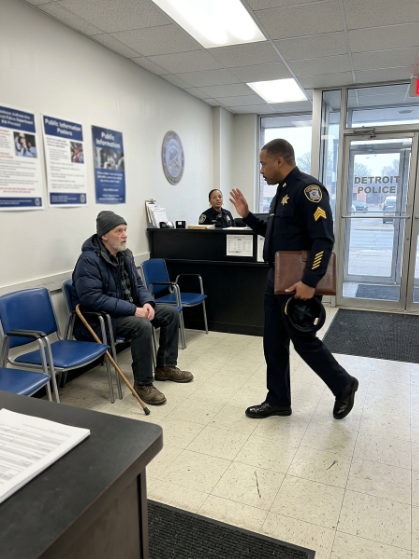
The chief was running late.
Daniel Brooks, forty-eight years old, three weeks into his promotion to Chief of the Detroit Police Department’s 8th Precinct, navy uniform pressed sharp by the precinct’s contract dry-cleaner that morning, brass star catching the fluorescent lobby light, leather portfolio under his left arm and his peaked cap in his right hand, was supposed to be at a press conference at City Hall in eleven minutes.
He waved off the elderly homeless man waiting in the row of plastic-and-vinyl lobby chairs without slowing down.
“Sir, the desk sergeant will help you. I’m late.”
The man in the chair did not move.
He was seventy-one years old, gray beard trimmed close, weathered face, a threadbare navy-blue down parka over a dark plaid flannel, dark gray knit cap, dark jeans, scuffed brown work boots, a wooden cane leaning against the chair beside him. He had been waiting in the third chair from the end since seven-fifteen that morning. He had brought, in the inside pocket of his parka, a small leather wallet that had been in his coat pocket since 1977.
He looked up at Daniel Brooks, very calmly, as the chief reached for the lobby door.
He said, “Daniel Brooks, born May fourteenth, nineteen seventy-seven. Henry Ford Hospital. Mother Karen Brooks, age twenty-two at the time. Father, no name listed.”
Daniel Brooks stopped mid-stride.
The reception sergeant, who had been pretending not to listen, looked up from her desk. The lobby went very quiet.
Daniel turned around. He walked back to the row of chairs. The chief of the Detroit Police Department’s 8th Precinct, in his pressed navy uniform with the brass star on his collar, crouched down in front of an elderly homeless man — ruining the press-conference creases on his uniform pants — and looked the old man in the face.
“Who are you,” Daniel said.
“My name is Wilbur Hayes,” the old man said. “I was a Detroit patrolman in the winter of nineteen seventy-seven. I was twenty-four years old. On the night of May fourteenth, at approximately one-eighteen a.m., I was off-duty walking south on Third Street when I heard a baby crying on the front steps of Saint Mary’s Catholic Church. I went up the steps. I found a three-month-old infant in a cardboard box, wrapped in a thin yellow blanket. The temperature that night was nineteen degrees.”
He took a breath.
“I took off my department-issue jacket. I wrapped the baby in it. I carried the baby to my car. I drove him to the Henry Ford emergency room. The nurse on duty registered him as Baby Doe, found at Saint Mary’s, May fourteenth, one-twenty-six a.m. The hospital named him Daniel because the priest at Saint Mary’s was named Daniel. I picked him up two days later when I was off-shift and held him for an hour while the Catholic adoption agency processed the paperwork. I was not allowed to take him home. The adoption agency placed him with the Brooks family in Bloomfield Hills three weeks later. The records were sealed under Michigan adoption law.”
He looked at Daniel.
“I went back to Saint Mary’s the next night. I went back every night for two weeks. I was looking for the mother. I did not find her. I have been looking for her, on and off, for forty-seven years.”
Daniel Brooks did not speak.
“Three weeks ago,” Wilbur said, “the Detroit News ran a brief item on the Michigan adoption-records unsealing law that took effect on March first. The item mentioned, by name, the chief of the 8th Precinct as someone who had quietly requested the unsealing of his own infancy records. I read the item yesterday. I walked four miles to this precinct this morning.”
He reached, very slowly, into the inside pocket of his parka.
He withdrew a small leather wallet. It was old. It was the size of a deck of cards. He opened it.
Inside, behind a yellowed plastic sleeve, was a Polaroid photograph. A young patrolman in a navy department-issue jacket holding a three-month-old baby in the emergency-room intake room of Henry Ford Hospital at one-thirty-six a.m. on May fifteenth, nineteen seventy-seven. The photograph was timestamped on the negative. The young patrolman was holding the baby with both hands, the way a man holds something he is afraid he is going to drop.
Wilbur Hayes was that young patrolman.
He handed the wallet across to Daniel Brooks, gently, the way you hand a wallet to a man who has not seen his own first photograph.
Daniel Brooks took it. He held it for a long count.
“Mr. Hayes,” he said, “what happened to you after.”
Wilbur Hayes did not lie.
“I had a difficult time, sir,” he said. “There was a 1983 incident that the department reviewed and ruled on without formal charge, but I lost my partner that night and I did not, in the years afterward, manage the loss well. My wife left me in 1989. My career ended in 1991. I have been in and out of housing for thirty years. I have been sober, this most recent time, for four years and three months.”
Daniel Brooks did not say anything for a long count.
Then he said, “Sir, the press conference is going to have to start without me.”
He stood up. He walked to the reception desk. He told the desk sergeant to call the mayor’s office and inform them that Chief Brooks had been delayed on a personal family matter. He walked back to Wilbur. He helped him stand. He picked up the wooden cane and handed it to him. He took his elbow.
He walked Wilbur Hayes out of the 8th Precinct lobby and into the parking lot, where his department car was waiting. He drove him to a small coffee shop on Woodward Avenue.
They sat there for three hours.
That afternoon, Daniel Brooks moved Wilbur Hayes into the spare bedroom of his house in Bloomfield Hills. The spare bedroom had a private bath, a window that looked out onto a small backyard, and a queen bed that Daniel’s wife Linda — who had been told the relevant facts on the phone at one in the afternoon — had made up with fresh sheets by three.
Six weeks later, with the help of a private investigator and the recently-unsealed adoption records, Daniel Brooks found his biological mother. Karen Brooks, sixty-eight, was alive and living in Toledo, Ohio. She had been searching for the baby she had left on the steps of Saint Mary’s, May fourteenth, nineteen seventy-seven, for forty-seven years. She had been nineteen and afraid. She had gotten clean in 1981 and had spent the four decades since trying to find him.
She came to Bloomfield Hills the following Saturday. Daniel Brooks introduced her to Wilbur Hayes in his living room.
She walked across the living room. She put her hands on either side of Wilbur Hayes’s face. She did not say anything for a long count.
Then she said, “Thank you, sir, for keeping him alive long enough for me to find him.”
Wilbur Hayes, who had not cried in four years and three months, cried.
The following spring, Daniel and Linda Brooks renewed their wedding vows in a small ceremony in the backyard of the Bloomfield Hills house. Daniel asked Wilbur Hayes to walk in beside him as he met Linda at the rose arch. Wilbur did. He wore a clean navy field cap with a small subdued unit patch on the front and a pressed white shirt that Linda had ironed for him that morning.
After the ceremony, Daniel Brooks gave Wilbur a small wrapped package.
Inside was a navy department-issue jacket from the Detroit Police Department, vintage 1977, in Wilbur Hayes’s size, restored at a leather shop in Hamtramck. The chief of the 8th Precinct had personally located it through an estate sale of a retired patrolman’s widow.
Wilbur Hayes put the jacket on. It fit. He kept it on for the rest of the evening. He kept it for the rest of his life.