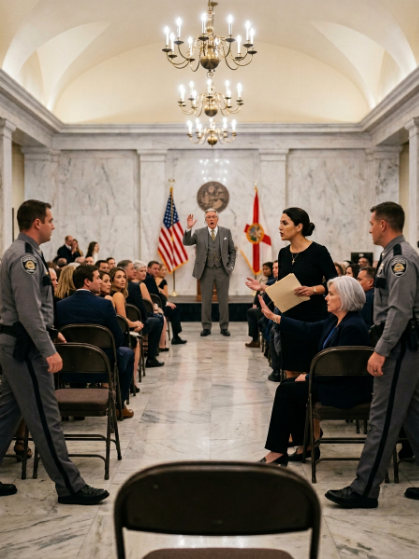
Robert Gantry, sixty-six years old, thirty-six years a Hillsborough County District Attorney, was three sentences into the part of his retirement speech he had practiced for two days in a hotel mirror.
The line was: “Thirty-six years of service to this county, and not one conviction overturned on my watch.” He had timed the pause after it. He had never delivered it before. He delivered it that Thursday evening in Tampa, in the great hall of the courthouse he had built his career inside, under a row of brass chandeliers, between a US flag and the Florida state flag, in front of a hundred and fifty colleagues in cocktail attire seated in folding chairs on the polished marble floor.
The pause came. The applause did not.
Instead, in the third row, a woman in a black professional knee-length dress stood up.
Diane Velasquez, forty-four years old, dark hair pulled back into a low chignon, simple gold cross necklace at her throat, a thin manila folder held in her left hand. She was on the staff of the Innocence Project’s Florida regional office. She was also a public defender by training, eleven years out of Florida State Law. She had been planning this evening for six years, two months, and fourteen days.
She did not raise her voice. She did not have to.
“Mr. Gantry. May I speak.”
Two security guards started moving from the side aisles, one from each side. They had been briefed at the door of the great hall on standard protocol for retirement-ceremony interruptions. The protocol was: gentle escort, no scene, conversation outside.
Frances Holloway, sixty-eight years old, clerk of court for the past twenty-three years, sitting in the front row in a navy blazer and black slacks, raised her right hand.
The two security guards stopped where they were.
Frances had known Robert Gantry for twenty-three years. She had filed thousands of motions for him. She had watched him win cases that should have been lost and lose cases that should have been won, and she had, twice in those twenty-three years, refused to sign a procedural document on the grounds that the document was not, in her judgment, properly supported by the record. Both times he had backed down.
She had recognized Diane Velasquez when Diane walked into the great hall thirty-five minutes earlier. She had recognized her by the manila folder. She had been hoping, for six years, two months, and fourteen days, that Diane would stand up.
“Mr. Gantry,” Diane said. “My brother Miguel served eleven years and four months in Raiford. Your office knew he didn’t do it. I have the memo.”
She walked, slowly, forward. Up the center aisle. Past row two. Past row one. To the front of the great hall, six feet from the brass podium where Robert Gantry was still standing with one hand frozen mid-rhetorical-gesture.
She opened the manila folder.
“This,” she said, holding up a single typed page, “is an internal memo dated July fourteenth, two thousand nine. It was written by then-Assistant District Attorney Garrett Kim, who left this office in twenty-twelve and now serves on the federal bench. The memo is addressed to then-Deputy District Attorney Sarah Park. It is carbon-copied to you, Mr. Gantry, by name and title.”
She turned the page so the room could see.
“The memo says, and I quote: ‘I have reviewed the eyewitness identification in the Miguel Velasquez case. The lineup was non-blind, the witness was given preferential coaching, and the photo array was not double-blinded. In my judgment, the identification is not reliable, and the case should be reviewed for dismissal before proceeding to trial. Failure to act on this memo could result in the conviction of an innocent man.'”
She lowered the page.
“My brother was convicted four months later. He served eleven years and four months. He was released in two thousand nineteen after the Innocence Project’s DNA work cleared him. The actual perpetrator confessed in two thousand twenty-one.”
She turned to face the audience. She was, at this point, very calm.
“I have been requesting this memo under FOIA for six years. The memo was finally released to me, in unredacted form, in March of this year, after the Eleventh Circuit ruled that internal prosecutorial memoranda subject to documented misconduct are not exempt under the law-enforcement carve-out. I have been waiting to deliver this memo to Mr. Gantry, in person, on the public record, before he retired.”
She walked to the podium. Robert Gantry did not step back. He did not step forward. He looked at her the way a man looks at a thing he had hoped, very deeply, would never arrive.
She placed the memo on the podium beside his prepared remarks.
“My brother is here tonight,” she said. “He came in late. He is in the back row. He would like, when this ceremony is over, to ask you one question. He has agreed to ask only one.”
Then she turned. She walked, slowly, back up the center aisle. Past the security guards, who did not move. Past Frances Holloway, who lowered her raised hand. To the back row, where a thirty-six-year-old man in a plain dark suit, who had been twenty-five years old when he was arrested, was sitting beside an empty chair he had been saving for his sister.
Diane sat down beside him. He took her hand.
The great hall stayed very quiet.
Robert Gantry did not finish his speech. He looked down at the memo on the podium for a long count. Then he stepped back from the podium. He folded his prepared remarks in half. He put them in the inside pocket of his three-piece suit.
He walked off the stage. He walked, very slowly, the length of the great hall to the back row. He stopped at Miguel Velasquez’s chair.
Miguel Velasquez stood up. He looked at the man whose office had cost him eleven years and four months of his life.
“Mr. Gantry,” Miguel said. “I have one question.”
“Yes.”
“Did you read the memo when it was sent to you in two thousand nine.”
Robert Gantry did not lie.
“Yes,” he said.
Miguel nodded. He did not say anything else. He sat down. Diane took his hand again.
Robert Gantry walked out of the great hall. He did not return.
The Tampa Bay Times ran the memo on its front page the following morning under a four-column headline. The Florida State Attorney’s Office opened a misconduct review the same day. Robert Gantry’s pension was placed under review. He resigned from his post-retirement position on three nonprofit boards within seventy-two hours.
The state of Florida settled with Miguel Velasquez, six months later, for an additional figure that was made public this time. Miguel used the settlement to start a free-of-charge legal aid clinic in Ybor City for first-time felony defendants who could not afford private counsel. Diane left the Innocence Project to be the clinic’s first director.
Frances Holloway retired three months after Robert Gantry. She came to the clinic’s opening. She was given the first official client folder to file. She handed it to Diane and said, “I have been waiting to file this one for twenty-three years.”
Then she signed her name on the first page, in her clean clerk’s hand, and walked out into the Tampa heat with a manila folder full of nothing under her arm — the way she had walked out of every courthouse for twenty-three years, except this time the folder was empty, because the work was finally being done by someone who knew where the truth had always been.