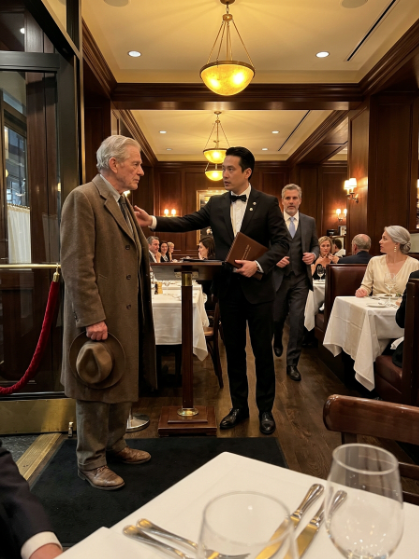
The whole dining room saw the old man at the door before they understood why a wealthy man across the room was already on his feet.
It was 7:42 p.m. on a Wednesday in March, in a small reservation-only Manhattan restaurant near Lincoln Center — twelve tables, a brass-mounted reservation podium, low warm pendant lights, dark wood paneling. The maître d’ at the podium, Sebastian Cole, forty years old, slick black hair, black two-piece suit, white shirt, clip-on bowtie, had been working the door for twelve years. He had a leather reservation book under his left arm and a trained eye for who, in his estimation, had walked through the wrong door.
The old man had walked through the wrong door at 7:42.
He was wearing a battered brown felt fedora, a threadbare wool overcoat that had once been dark and was now the color of old earth, a faded blazer underneath, a dark tie, and scuffed brown leather shoes that had been polished that morning. He was seventy-eight years old. His name was Charles Whitfield. He had not, until that morning, been certain he was going to come in.
Sebastian had stepped from behind the podium with the practiced grace of a man who had done this hundreds of times, one arm gently extended toward the door, body angled to send the old man back outside without making a scene.
“I’m sorry, sir, this establishment is reservation-only and the dress code is strictly enforced.”
Charles Whitfield did not argue. He took his fedora off — a small courtesy he had been raised on — and held it in his left hand at his side, hands at his sides, quietly waiting to be told to leave. He had not made trouble in seventy-eight years.
That was when, at the banquette nearest the front door, Paul Henderson stood up.
Paul was fifty-two years old, charcoal three-piece suit, light-blue silk tie, salt-and-pepper hair, silver wedding band. His wife Elena, fifty-one, in her cream silk dress and pearl earrings, half-rose from the same banquette without quite knowing why. She put a hand on his sleeve as he stood. He did not stop. He had, in twenty-six years of marriage, only once before stood up from a restaurant table the way he was standing up now, and that had been the morning Elena had told him she was pregnant with their first child.
Paul started walking. He passed three tables of cocktail-attire diners, all pretending not to notice. He stopped behind the maître d’.
“Sebastian,” Paul said. “Step aside, please.”
Sebastian, who had been seating Paul and Elena Henderson at the same booth on the second Wednesday of every month for eight years, did not immediately step aside. He looked at Paul. He looked at the old man. He looked back at Paul.
“Paul, the gentleman doesn’t have —”
“He’s just early,” Paul said. “With me.”
Sebastian’s arm dropped to his side.
Charles Whitfield, who had not yet looked at Paul Henderson, looked at him for the first time. He did not recognize him. He had no reason to. He had not, in thirty-eight years, met the man who had once slept on the third bunk on the third row of the men’s dormitory at the Bowery Mission shelter on Lafayette Street under the name Paul H., a young man who had refused to give his last name on his intake form.
Charles had been the director of the Bowery Mission for forty-three years. He had run the men’s dormitory, the soup kitchen, and the Tuesday-morning job-search workshop. He had never charged anyone for a meal or a bed or a bus ticket. He had retired three months ago, after a stroke had reduced his right-hand grip. He had moved into a small studio on the Lower East Side. The Times had run a small retrospective on him in the Metro section that morning, with a line at the end that read: “Mr. Whitfield can occasionally be found, these days, looking for somewhere quiet to have a hot meal.”
Paul had read the line at his breakfast. He had folded the paper. He had not said anything to Elena. He had gotten on the phone with the maître d’ at lunchtime. He had told Sebastian he might have a guest. He had not said who.
He had not, for thirty-eight years, known the name of the man who had given him a hot meal and a clean shirt and the bus fare to a 1987 job interview that had been the start of everything Paul Henderson had ever built.
He had been looking for him.
Paul stepped past Sebastian. He took Charles Whitfield’s overcoat at the elbow, very gently, the way you take an old man’s elbow to help him through a doorway. He did not say his name yet.
“Sir,” Paul said, “I wonder if I might have the privilege of buying you dinner. My wife and I have a banquette by the window. We have been holding the third chair empty for thirty-eight years. I think tonight is the night.”
Charles Whitfield did not understand. He came in anyway.
Paul walked him to the banquette. Elena, who had heard nothing of what had been said at the door but had read everything in her husband’s spine as he crossed the dining room, slid over to make room for Charles. She took the fedora out of his hand, very gently, and set it on the brass coat hook behind the booth.
Paul sat across from him. He waited until the bread had been brought and the water had been poured.
Then he said, “Mr. Whitfield. My name is Paul Henderson. I slept in the third bunk on the third row of the men’s dormitory at the Bowery Mission for four months in the spring of nineteen eighty-seven. I refused to give my last name on the intake form. I asked for a piece of paper to write my mother’s address on. You gave me a piece of paper. You also gave me, the morning I left, a hot meal, a clean shirt, the use of the office telephone, and a five-dollar bill for the bus to a job interview. I never told you my name. I have been looking for you for thirty-eight years. I read the Times this morning. Thank you for coming in tonight.”
Charles Whitfield did not say anything for a long count.
Then he reached, very slowly, with a hand that had once steadied a kettle for forty-three years, across the white linen tablecloth, and put his hand on Paul Henderson’s forearm.
“I remember you,” he said. “You wrote your mother in Schenectady. Every other Tuesday.”
Paul Henderson, who had not cried in front of his wife since the morning their first child had been born, cried.
Three months later, Paul Henderson bought the small studio on the Lower East Side that Charles had moved into after his retirement, paid off the building’s mortgage in full, and renegotiated Charles’s rent to be one dollar a year for the rest of his life. He set up a private foundation in Charles’s name with an endowment of fourteen million dollars, the proceeds of which would fund the Bowery Mission’s transitional housing program in perpetuity.
Charles Whitfield ate dinner at the Henderson banquette on the second Wednesday of every month for the next four years. He always wore the same battered brown felt fedora. Sebastian, who had asked Paul to please tell him the rest of the story, never again let an old man in a worn coat be sent back through the door of his restaurant without first checking the reservation book under every name.
Charles died on a Wednesday in his sleep. Paul Henderson was the executor. The estate consisted of the fedora, a small wooden shoeshine kit, three photographs, and a piece of paper folded into eighths. The piece of paper had been written on, in 1987, in a young man’s careful handwriting, in pencil. It was a Schenectady address.
Paul folded it back along the same creases. He put it in the inside pocket of his charcoal jacket. He carried it for the rest of his life.