The major donor was due to arrive in eight minutes.
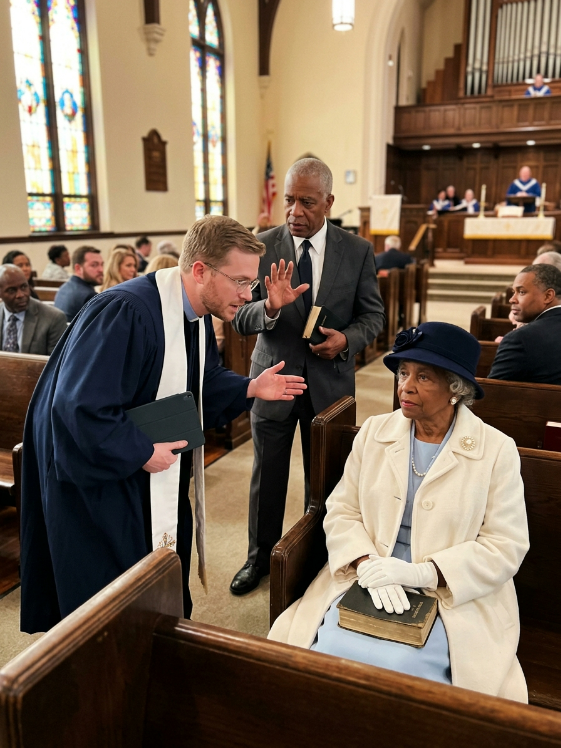
Reverend Thomas Hale, thirty-eight years old, three weeks into his pastorate at Wesley Methodist of Charleston, had his tablet under his arm, his stole crooked from rushing, and a problem in the front pew. He had been told by the senior administrator twenty minutes earlier, in the parlor, that the gentleman arriving at ten o’clock was going to make “a substantial gift” to the building campaign, and that the gentleman, a lifelong Methodist, was a “particular man” who liked to sit in the front pew of any sanctuary he visited for the first time. Thomas had nodded and gone to the sanctuary.
The front pew was occupied.
Eighty-four-year-old Margaret Whitfield had been sitting in that exact pew, exact spot — three feet from the aisle, on the right-hand side facing the altar — every Sunday for as long as anyone in the choir loft could remember. She was, on this Sunday, dressed the way she always was: navy felt church hat with a small silk flower at the brim, white wool tea-length coat over a pale-blue Sunday dress, pearl brooch at the collar, white gloved hands folded over a worn personal hymnal in her lap. The hymnal had her late husband’s name embossed in faded gold on the cover. She had been holding it for fifty-six years.
She did not know about the donor. Nobody had told her. She had walked in at 9:42 with the choir.
Thomas leaned down to her at 9:52, voice low and apologetic-but-firm. He had been a pastor for nine years. He had moved old members out of pews exactly twice in nine years. He had not enjoyed it either time.
“Sister Margaret,” he said. “Would you mind moving back a few rows? We have a major donor visiting today and I need this row reserved.”
Margaret looked up at him.
She did not move. She did not even open her mouth. The morning sun was coming through the tall stained-glass windows in long jewel-toned panels — ruby, cobalt, gold — and one of the panels fell across her hat and her gloved hands and the worn hymnal in her lap. She looked at Thomas the way she had looked at her sons when they were boys and had asked her something she was not going to answer with a word.
Thomas, who could hear the eight-minute clock ticking in his head, leaned a half-inch closer.
“Sister Margaret. I do apologize. The gentleman is arriving in just a few minutes. Perhaps the second pew, just behind, would —”
“Pastor.”
The voice came from the second pew, two rows behind. It carried because the sanctuary was very quiet at 9:53 on a Sunday morning, when the organist had finished the prelude and the congregation had not yet begun the opening hymn.
Deacon Ellis Greene, sixty-one years old, charcoal suit, white shirt, dark tie, gray hair close-cropped, hymnal in his right hand, stood up from the second pew, stepped into the center aisle, and lifted his left hand the way a man stops a car at a crosswalk. He walked the four steps to where Thomas was standing over Margaret.
He did not raise his voice. He spoke just loud enough for the front three rows to hear.
“Pastor,” Deacon Greene said. “Sister Margaret founded this congregation in nineteen sixty-eight. In her living room. With eleven people. The land you are standing on was deeded to this congregation by her family in nineteen seventy-one, on the condition that she always sit in the front row. The condition has been honored for fifty-four years. The major donor you are expecting is her grandson. He is bringing her quarterly check. She is the donor, Pastor. She has always been the donor.”
Thomas’s apologetic-but-firm posture collapsed mid-gesture.
He did not say anything for a count of four. The choir loft fell perfectly silent. The organist’s foot lifted from the pedal. The early arrivals in the back of the sanctuary were now, with no movement and no sound, paying perfect attention.
Margaret, in the front pew, had not moved.
Thomas turned, very slowly, back to her. He sat down — on the front pew next to Margaret, on the aisle side, leaving the three feet of pew between them where the donor was supposed to sit. He set his tablet on his lap. He folded his hands over it. He looked at the worn hymnal with her late husband’s name on it.
“Sister Margaret,” he said. His voice had gone very small. “I apologize. Would you tell me about your husband, please.”
Margaret looked at him for a long count.
Then she smiled, very slightly, the smile she had been smiling at thirty-eight-year-old men for sixty years.
“His name was Charles,” she said. “He was a Methodist preacher in this state for thirty-six years. He passed in nineteen eighty-nine. We started this congregation in our living room because the church we had been members of had a list of people they would not serve communion to. We did not agree with the list. So we left. With eleven people. And we built this.” She gestured, very slightly, with her gloved hand toward the sanctuary, the choir loft, the stained glass.
“Yes ma’am.”
“You did not know that.”
“No ma’am. I did not. I should have. I am sorry.”
“Pastor,” Margaret said, “you have been here three weeks. There is much you do not know yet. That is acceptable. What is not acceptable is moving an old woman out of a pew because a man with money is coming. I would like you to remember that, please. For the next thirty-six years.”
“Yes ma’am.”
“Now,” Margaret said, “the organist is going to start the opening hymn in approximately ninety seconds, and you have a service to lead. My grandson will arrive at ten o’clock, as scheduled. He will sit in the second pew, where Deacon Greene was sitting. I will sit where I have sat since nineteen sixty-eight. Are we agreed.”
“Yes ma’am.”
“Stand up, please, Pastor. You have a sermon to preach.”
Thomas stood up. Margaret reached up — she had to reach up; she was four foot eleven seated and he was six foot two standing — and she straightened the stole on his shoulders the way she had straightened her late husband’s stole on a thousand Sunday mornings between 1953 and 1989. She patted his lapel. She nodded.
The organist struck the first chord of “Holy, Holy, Holy” at exactly 9:55. The congregation stood. Thomas, very quietly, opened his hymnal. Margaret, very quietly, opened hers. Deacon Greene, very quietly, returned to his seat in the second pew.
At 10:02, Margaret’s grandson — a forty-six-year-old commercial-real-estate attorney named David Whitfield, who was, in the relevant tax year, the second-largest individual donor to the Methodist Conference of South Carolina — slipped quietly into the second pew next to Deacon Greene, having driven in from Atlanta the night before specifically so he could deliver his grandmother’s quarterly contribution to her own congregation in person. He had a folded check in his coat pocket made out for one hundred and twenty thousand dollars. He had been bringing one of those checks every three months for nine years, drawn from a fund she had quietly established in 1971.
Reverend Thomas Hale preached on humility that morning. He had not planned to. He preached on humility for nineteen minutes. At the end of the service, he walked down the aisle from the pulpit, stopped at the front pew, took Margaret’s gloved hand, and helped her to her feet. He walked her down the aisle himself, past her grandson, past Deacon Greene, past the congregation she had built in her own living room fifty-six years before.
She did not let go of his arm until they reached the bottom of the steps.
Then she said, “You’ll do fine, Pastor. Just don’t move me again.”