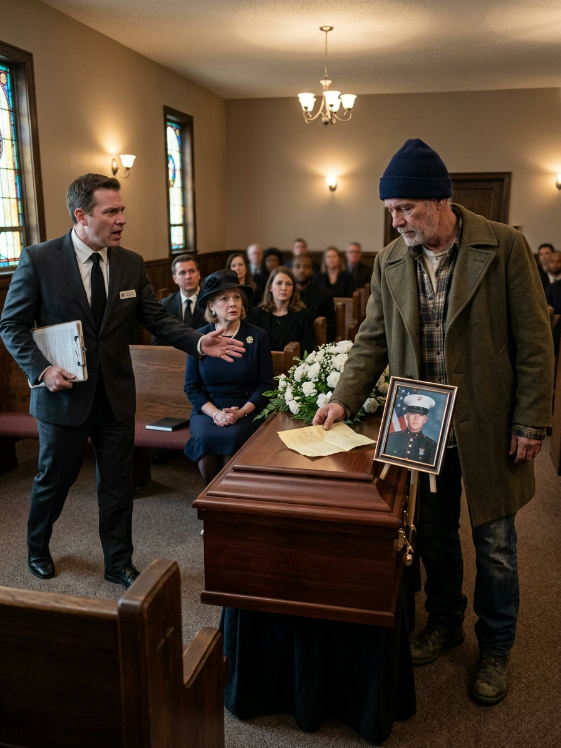
Nobody at the funeral knew the homeless man, and nobody had invited him.
He came in through the side door of the small Cleveland funeral parlor at 10:47 a.m., during the third hymn, when the back of the chapel was still quiet enough that the mourners did not all turn at once. He walked the long center aisle in scuffed brown work boots and a threadbare olive wool overcoat that had once been a Marine field jacket and was now what a man wore who had nothing else to wear. The navy knit cap stayed on his head. The gray stubble had not been trimmed in two days. His hands were red from the cold.
He walked past the back rows. He walked past the middle rows, where the deceased’s two younger sisters had each, at the same moment, half-stood and then sat down again because they did not know what else to do. He walked past the front pew, where Helen — the widow, sixty-three, navy mourning dress, black hat with a sheer veil, pearl earrings — was sitting with her hands folded in her lap. He did not look at her. He looked at the casket.
The polished dark-wood casket sat centered on a draped stand at the front of the chapel. The white floral spray ran the length of the lid. To the left of the casket, on a small easel, was a framed photograph of the deceased — Master Sergeant Thomas Kasprak, US Marine Corps, retired — in dress blues, taken at the unit reunion in 2018, the year before the cancer was diagnosed. To the right, a single American flag stood folded in a triangular case.
The homeless man stopped at the casket. He did not put his hand on the wood. He did not lean. He reached into the inside pocket of his overcoat and took out a folded letter. Yellowed legal paper. Edges soft from being carried for years.
He set the letter down on the polished wood next to the framed photograph, with both hands, the way you set down something that has finally arrived where it was supposed to go.
That was when Charles Briggs, the funeral director, started moving from the side aisle. Twenty-eight years in this work, clipboard under his arm, name badge on his lapel, a clear procedure for unauthorized attendees. He was already drawing breath to say, very quietly, “Sir, I’m going to need you to step out with me.”
He did not finish the sentence.
Helen, in the front pew, stood up.
She did not stand quickly. She stood the way women stand at funerals when something they have been waiting for has finally happened. She walked the four steps from the front pew to the casket. The chapel did not breathe. Charles, halfway down the aisle, stopped where he was.
Helen picked up the letter.
She did not unfold it right away. She held it for a moment in her gloved hand and looked at the homeless man — not at his clothes, not at the cap, but at his face — and she nodded, once. The homeless man, who had not yet said a word, nodded back.
Then she unfolded the letter.
It was three pages, in her late husband’s handwriting. The handwriting was unmistakable. She had read his handwriting on grocery lists and birthday cards and field-day permission slips for thirty-six years. She read the first line. She read the second. She read the third. Her hand went to her mouth.
The first line was the date: three weeks before Tom died.
The second line was the address: a P.O. box in Akron that Helen had not known existed.
The third line was: Walter, my brother by every definition that matters. By the time you read this, I will be gone.
Helen closed her eyes for a count of three. She opened them. She turned slowly to face the chapel and said, in a voice that carried because the chapel was very quiet, “This man is Walter Kasprak. He served with my husband in Mosul in nineteen ninety-one. My husband and I have been writing to him for twenty-two years. He is the reason my husband came home alive. He is family. I would like him to sit in the front pew.”
The chapel did not move. Then Tom’s two younger sisters stood up at the same moment in the second pew, and the elder, Janice, said, “Aunt Helen. Bring him over.”
Charles Briggs had not moved. He was looking at Walter. Walter was looking at Helen. Helen was looking at no one in particular. She was just standing at her husband’s casket, holding a letter she had been waiting twenty-two years to read, in front of two hundred people who, until thirty seconds ago, had thought they understood the man in the box.
Walter walked the four steps to the front pew. He did not take off the navy knit cap. Helen did not ask him to. She sat down. She motioned for him to sit beside her. He did. The pew creaked softly under his weight. He smelled of the cold and of cheap coffee. He folded his hands in his lap.
Helen handed him the letter. “Read the rest of it,” she said. “I’ll wait.”
Walter read the letter, slowly, the way men of a certain age read letters when their eyes are not what they used to be. Helen sat next to him with her gloved hand resting lightly on his sleeve. Charles Briggs, who had remembered, twelve seconds late, that he was a funeral director and not a security guard, walked very quietly back to the side of the chapel and resumed his post by the door.
The service continued.
The letter, which Walter folded back into thirds and put into the inside pocket of his own overcoat at the end of the homily, told a story that took most of three pages to tell. It said that Tom Kasprak had been pulled out of a culvert in Mosul on the night of October fourteenth, 1991, by a corporal named Walter Kasprak — no relation, just the same last name, which had been a small joke between them for thirty years — who had carried Tom four hundred yards across open ground with shrapnel in his own thigh and had not stopped to be evaluated until Tom was on a Medevac. The letter said that when Walter came home and his wife left him and the PTSD took the rest, Tom and Helen had set up a small family trust through a P.O. box in Akron, and that for twenty-two years they had paid Walter’s rent at a single-room residency on East Ninetieth Street, and his utilities, and his prescriptions. The letter said: I never told you, brother, because you would have refused. The letter said: Helen has always known. Sit in the front pew. That is where you belong.
After the service, Helen brought Walter to her house. She did not ask him to take off the navy knit cap. She made him a sandwich. He ate it. She made him another. He ate that too. Then she put him in the small guest room over the garage that Tom had built, in 2003, “for any brother of mine who ever needs it,” and Walter slept in a bed for the first time in eleven years.
Helen called the trust office the next morning. She extended it indefinitely, in her own name, for the rest of Walter’s life. She also called the family attorney and had Walter added to the deed of the small fishing cabin Tom had owned outside Sandusky — the cabin Tom had been planning to deed to Walter in his will but had not yet done because he had been waiting to feel well enough to drive up there one more time. He never had felt well enough.
Walter took the cabin. He stayed sober. He learned to cook, because Helen taught him. He came to Sunday dinner every week.
Three years later, on the morning he died, Walter Kasprak was found in the front pew of the same small Cleveland funeral parlor, where he had been visiting Tom’s memorial brick on the inside wall, the way he visited every Sunday after church. He had a folded letter in the inside pocket of his overcoat. The letter had been read so many times the creases were soft. Charles Briggs, who was the funeral director for Walter’s small private service three days later, recognized the handwriting on it. He did not unfold it. He laid it on the polished wood of Walter’s casket, beside the framed photograph of Walter in his old field jacket, and he stepped back and did not say anything. He had learned, three years before, when not to say anything.