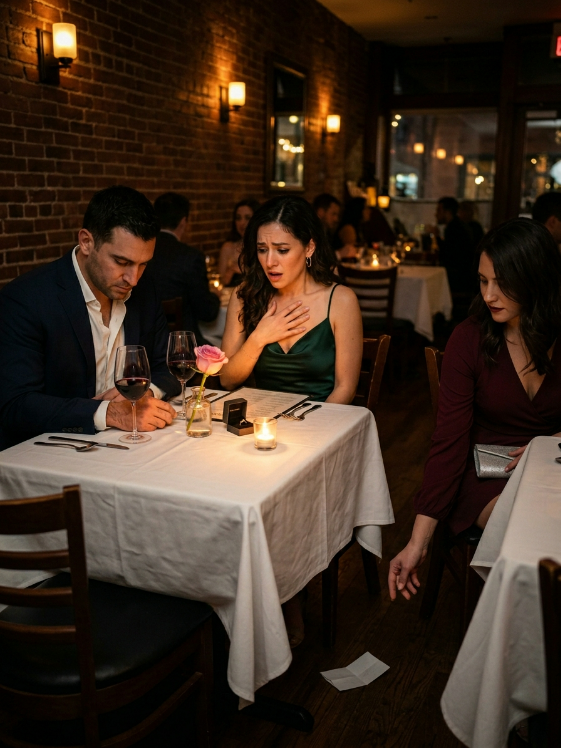
“I’m sorry. I can’t do this anymore.”
James Ortiz did not look up when he said it. He slid the open ring box back across the white tablecloth toward Amelia Park, the woman he had been with for three years and one month, the woman he had been planning to marry next May, and he kept his eyes on the wood. He had practiced this exact apology for two days. He did not get it right. The ring caught a sliver of candlelight on its way across the linen and threw a thin gold line up onto Amelia’s chin.
Amelia did not move. Her hand had gone up near her chest, the way hands go up near chests when the body has not yet decided whether to fight or to flinch. The small Italian restaurant in Boston’s North End — exposed-brick wall, warm amber sconces, a single pink rose in a small glass vase, a candle flickering between them — stayed warm and quiet. A waiter passed in the background carrying a tray and did not look at their table.
James’s hands were shaking.
This was the detail Amelia, even in the first second, could not stop noticing. James’s hands had not shaken once in three years. Not on the night his mother went into the hospital. Not on the morning his startup lost its lead investor. Not on the evening, six months ago, when he had told Amelia about the diagnosis his father had received before the family knew. Steady hands. The steadiest in any room he was in. And tonight, in the candlelight at the back of the restaurant where they had eaten on every anniversary they had ever had, his hands were shaking.
Three tables over, Olivia Park — Amelia’s twenty-seven-year-old sister, sitting with her husband Daniel — saw it before Amelia did.
Olivia had been there as a witness, technically. Tonight was not the proposal night; that had been six months ago. Tonight was the night Amelia and James had reserved to go through the wedding-venue shortlist, and Olivia had asked, two days ago, if she could “just stop in for dessert” because she wanted to see Amelia’s face when she found out James had already paid the deposit on the venue Amelia had said in passing was her favorite. The deposit had been paid on Monday. The receipt was, at this exact moment, folded in the inside breast pocket of James’s jacket.
Olivia, who was the kind of person who noticed things her sister did not notice about the men her sister loved, had spent the previous twenty minutes watching James’s face. She had watched the color go and not come back. She had watched him pick up his fork twice and not eat anything off either of them.
She had eight words on her lap. She had written them on a square of cocktail napkin while she was in the bathroom four minutes earlier, after she had texted James — texted, not called — and after he had texted back two words and a date.
She had the napkin folded into a small square, on her lap, when she heard James say, “I’m sorry. I can’t do this anymore.”
She did not stand up. She slid the napkin off her lap, onto the floor, under the lip of the tablecloth, and across the floor with the side of her foot until the corner of it came to rest against Amelia’s left shoe.
Amelia, who could feel her sister doing something even though she could not see it, looked down.
She picked up the napkin. She unfolded it under the table. She read eight words in her sister’s handwriting: He found out two days ago. Stage four. Don’t let him do this.
Amelia did not gasp. She did not cry. She did, very quietly, set the napkin down on the white tablecloth next to the half-finished glass of red wine, refold it, smooth the crease along the edge with the side of her thumb, and stand up.
James, who had been waiting for her to push the ring box back across to him, looked up for the first time in two minutes.
“James,” Amelia said. “Walk outside with me.”
“Amelia, I —”
“Now.”
She did not pick up the ring box. She did not pick up her clutch. She walked out of the restaurant in her emerald slip dress and her gold hoop earrings and the rain on Hanover Street caught her in the face the second she stepped through the door. James followed her. He did not pick up the ring box either. Olivia, three tables over, sat very still and put her hand on her husband’s wrist.
Amelia walked twenty feet from the door of the restaurant, past the canopy and into the rain, and stopped in front of the closed flower shop two doors down. The light from the shop’s window was a pale blue-gray. The rain was small and constant.
She turned around.
“Two days ago,” she said.
James had stopped six feet from her. The rain was already in his hair. His hands had stopped shaking, the way hands stop shaking when there is no longer any point in pretending.
“I was going to tell you next month,” James said. “After the venue. I wanted you to have the venue night. I wanted that one for you.”
“James.”
“Pancreatic. Stage four. Doctor Patel at Mass General. She gave me four to nine months. Eight, on average. Maybe ten if the trial works. The trial probably won’t work.” He stopped. His jaw was doing something. “Amelia, you are twenty-nine years old. You are going to spend the next three years watching me die in a hospital bed and the five years after that explaining to people why you are not married yet. I will not let that happen to you. I would rather you hate me. I would rather you remember me as the man who was a coward than as the man who did that to you.”
Amelia did not say anything for a long count.
Then she walked the six feet between them, in the rain, in her emerald slip dress, and she put her hands on either side of James’s face the way she had put them there a thousand mornings in her own kitchen, and she said:
“James. Listen to me. I am not asking. You do not get to make this choice for me. We are getting married. We are going to do every single venue tour. We are going to drink your father’s whiskey on Sunday nights and we are going to fight about the song list and argue about which weekend in May we want, and on Monday morning we are going to call Doctor Patel together, and I am going to be in that room for every single appointment. You do not get to decide what I deserve. I have already decided. I decided a year and a half ago, James. You were just slow.”
James started to say her name.
“And if it is eight months, James, then it is the eight best months of my life and I will know that for the rest of my life. And if it is ten years, then it is ten years. And if it is one. It is one. But you do not get to walk out of a restaurant in Boston and decide for me what I am or am not strong enough to live through. I am stronger than you have ever given me credit for. And I am marrying you, James Ortiz, on the second weekend of May, in the venue you already paid the deposit on, whether you like it or not.”
James’s knees, very slowly, gave.
He did not fall. He sat down on the wet curb in front of the closed flower shop. Amelia sat down next to him. The rain came down. He put his hands over his face. He cried, quietly, the way men cry when they have been holding it for a very long time. Amelia did not say anything. She just put her arm across his back and waited.
After a while, James said, “I forgot the ring on the table.”
“Olivia has it,” Amelia said. “She’ll bring it.”
“I love you.”
“I know. Stand up. We’re going home.”
They were married on the second weekend of May in a small venue outside Brookline. Doctor Patel attended the ceremony. The trial worked better than the trial usually worked. James was alive seven Mays after that, and twelve, and on the morning of the thirteenth anniversary he sat on the floor of their kitchen with their daughter and folded a small piece of cocktail napkin into her hand without explaining it, and told her she was named after her aunt, and that her aunt had once written eight words on a napkin in a bathroom in the North End and saved his life.s old field jacket, and he stepped back and did not say anything. He had learned, three years before, when not to say anything.