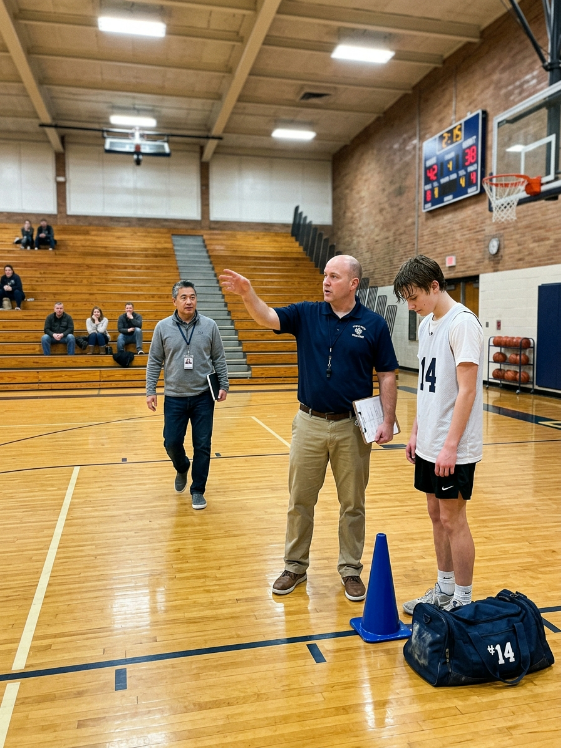
Friday night cuts at Lincoln South High School came at 8:47 p.m., and Coach Mark Reilly read the names off his clipboard the way he always did — alphabetical, no pause, no eye contact. “Davis. Cole. Henderson. You’re cut. The rest of you, full court tomorrow at six.”
Eli Henderson, sixteen years old, five foot seven, jersey damp from two hours of cone drills and shuttle runs, did not move. His gym bag was at his feet. He had been waiting for Reilly to look up. Reilly had not looked up.
In the upper bleachers of the suburban Cincinnati gym, where the fluorescent overhead lights bounced off the polished maple floor and made the empty rows of wooden seating look like an empty cathedral, a man in a gray quarter-zip pullover closed a black notebook and slid the pen behind his ear. He had been writing for two hours. He stood up. He started walking down.
The first parent who noticed was Eli’s mother, in row eight on the home side, who turned her head because she recognized the man’s face from a photograph her son had taped inside his closet. The second was Reilly’s wife, who turned because the clack of professional dress shoes on aluminum bleacher steps in a high school gym at 8:47 on a Friday night is not a sound you ignore.
By the time the man in the gray pullover had descended six rows, eleven of the twelve scattered parents in the gym had turned to watch him. He was not hurrying. He was walking the way men walk when they have already decided they are not leaving without doing the thing they came to do.
Coach Reilly was still on his clipboard. He had moved on to logistics for Saturday’s full-court session. He was telling the remaining boys to bring their own water bottles and not to be late. He had not once looked at the bleachers since the cuts started.
The man reached row two. He stepped down to row one. He stepped onto the gym floor.
Eli, still standing on the sideline next to his gym bag, head tilted slightly down, finally looked up. He saw who was walking toward Coach Reilly. His hand went very slowly to the silver chain his grandfather had given him on his fourteenth birthday — three thin links, hidden under the practice jersey collar — and held it.
The man in the gray pullover stopped six feet from Coach Reilly. He did not introduce himself. He did not say excuse me. He said, in a voice loud enough to carry to the back row, “Coach. I drove three hours to watch number fourteen specifically. He’s got the fastest forty-time I’ve recorded all season. I’d like to know on what evaluation system you just cut him.”
Coach Reilly, for the first time in two hours, looked up from his clipboard.
The professional lanyard around the man’s neck had a photo badge clipped to the bottom of it, and the badge faced outward. PACERS PRO PLAYER DEVELOPMENT. DANIEL CHO. SENIOR SCOUT.
Coach Reilly’s face did three things in three seconds. First it went blank. Then it went red. Then it tried to find a smile that didn’t quite arrive. “I — Mr. Cho — I wasn’t aware that —”
“You weren’t aware that the kid you just cut has been on our developmental watch list since June,” Daniel said. He was not unkind. He was just very precise. “You weren’t aware that I have logged thirty-one of his AAU games on tape this summer. You weren’t aware that his lateral quickness is in the top one percent of his class nationally. You weren’t aware that I drove from Indianapolis at three in the afternoon today specifically to watch you make this cut, because we wanted to confirm one thing.”
“What — what was that,” Coach Reilly said.
“That you couldn’t see him,” Daniel said. “And we have confirmed it.”
Eli, on the sideline, had not moved. He was breathing carefully, the way you breathe when you have decided not to let your face do anything.
Daniel turned to him. “Mr. Henderson. I’d like five minutes of your time, if your mother is here.”
Eli’s mother was already coming down from row eight. Her hands were shaking. She had not breathed properly in six minutes.
“Yes,” Eli said. “She’s here.”
Daniel turned back to Coach Reilly. “I’d ask the team to give us the gym for ten minutes,” he said. “I’d also ask you, Coach, to call the athletic director. He’s going to want to be part of this conversation. Not the one you and I are about to have. The one between you and him, after I leave.”
Coach Reilly opened his mouth. He closed it. He turned to the boys still on the floor — twelve of them, now standing in a loose semicircle, all of them watching their coach stop being their coach — and waved them toward the locker room without making eye contact with any of them.
The boys did not move at first. Then one of them — a senior named Devon Marsh, who had played JV with Eli for two years and varsity for one — said, “Coach. Did you film this tryout?”
Coach Reilly said nothing.
“Did you film any of his summer games? AAU? Any of them?”
Coach Reilly said nothing.
Devon shouldered his gym bag. He walked over to Eli. He put his hand on the back of Eli’s neck the way older brothers do. He said, “I’ll see you Monday, Henderson. You’re not done at this school. You’re just done in this gym.”
Then he walked out, and the rest of the team walked out with him.
Daniel waited until the gym door closed. Then he turned to Eli’s mother.
“Mrs. Henderson,” he said. “We’re inviting your son to our regional development camp in three weeks. Travel and lodging covered. He’ll be evaluated by four senior scouts, including me. There will be sixteen kids invited from the Midwest. Eli is the only one from this state. We’ve been waiting on him to clear high school cuts to extend the offer because we wanted to see how he handled a setback. He handled it.” Daniel paused. “Quietly. Which is the sixteenth of sixteen things we evaluate. He passed all sixteen.”
Eli’s mother was crying without sound, the way she had cried in the hospital the night Eli was born small. She nodded.
“Eli,” Daniel said. “I’d like you to skip JV this year. We’d like you to play on a USA Basketball developmental select roster instead. You’ll travel six weekends a year. You’ll keep your grades up at this high school but you will not play for this coach. Is that something you would consider.”
Eli, who had said nothing since “yes, she’s here,” looked at Coach Reilly. Coach Reilly was not looking at Eli. Coach Reilly was looking at his clipboard, which he was still holding, which now had nothing on it that mattered.
“Yes sir,” Eli said. “I’d consider it.”
Three weeks later, the Lincoln South athletic director put Coach Mark Reilly on administrative leave pending a review of the basketball program’s selection methodology. The review uncovered six other talented players cut over a four-year window, three of whom had since left organized basketball entirely. Reilly resigned during the review. The new coach — a former assistant who had been quietly logging summer AAU film for three years on her own time — was hired the week before Christmas.
Eli Henderson made the USA Basketball developmental roster. He played his senior year on a select team, averaging fourteen points and six assists, and signed his letter of intent to a Big Ten program in the spring.
The first time he flew home for break, he came to the Lincoln South gym, not to play, but to stand at the same spot on the sideline where his gym bag had been on the night he was cut. Devon Marsh, by then a freshman point guard at a small college two hours away, was visiting too. They stood there together in the empty gym.
“You ever wonder what would’ve happened,” Devon said, “if that scout hadn’t been in the bleachers.”
Eli touched the silver chain under his practice jersey. He did not answer right away.
“He was always going to be in the bleachers,” Eli said finally. “Somebody was. The cut just told us who.”
Then he picked up a basketball off the rack, dribbled it once, twice, and shot a long three-pointer that snapped the net clean — and turned, in the silent gym, to walk back out.