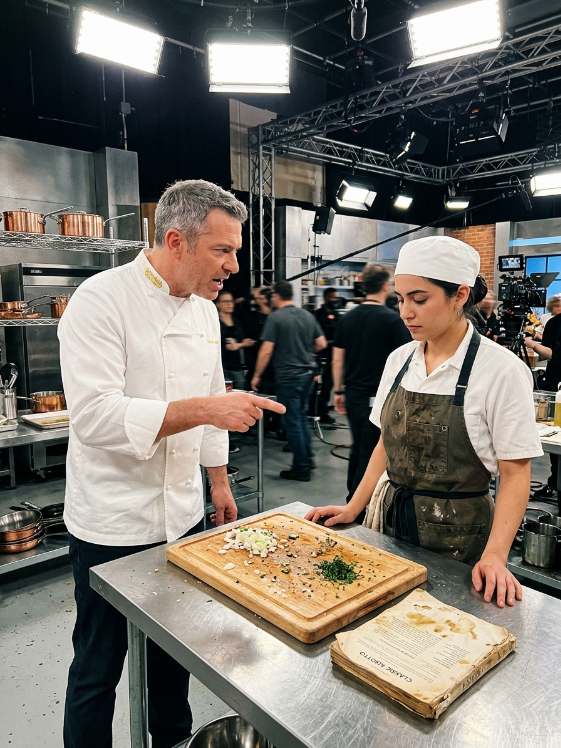
“I am sorry if my presence is an inconvenience to you, Chef,” Mia said quietly, her voice calm despite the cameras recording her live in the New York television studio kitchen. She stood by the stainless steel prep table in her stained kitchen apron, her hands resting flat on the cold metal surface. Celebrity Chef Antoine stood opposite her in his pristine double-breasted white chef’s whites, his face filled with mocking arrogance as he pointed his finger aggressively at her cutting board.
Antoine sneered at her knife technique, telling the live audience that a low-status line cook with no formal training was ruining his famous signature dish. Mia did not argue. She was twenty-four, with dark hair tucked neatly under a white chef’s hat, her face calm and composed under the intense heat of the studio spotlights. To the millions watching at home, she was just a nameless assistant, a kitchen hand meant to prep ingredients and stay out of the spotlight.
“Look at this mess,” Antoine scoffed, turning toward camera three with a dramatic roll of his eyes. “The julienne is uneven. The prep is slow. Fictional characters only. Fictional Antoine Financial and Culinary brand is built on absolute precision, and this is why we don’t hire amateurs to work in elite kitchens. You are finished on this show. Step away from the station.”
A few production crew members in the background shifted uncomfortably, but no one spoke. In the high-pressure, high-ratings world of celebrity television, Antoine was king, and his word was absolute law.
Mia quietly set her utility knife down on the cutting board. She had spent three years working eighteen-hour days in the hot, windowless prep kitchen of Antoine’s flagship restaurant, doing the exhausting, invisible work that made his empire possible. She had never asked for fame, but she had expected at least a shred of professional respect.
Instead of walking off the set in tears, she quietly reached into the pocket of her stained apron and pulled out a single, dog-eared, oil-stained cookbook page. She placed it flat on the stainless steel counter, right next to the cutting board, under the bright, hot studio lights.
During a brief segment transition as the cameras panned away for a sponsor break, the show’s lead producer, Sarah, stepped onto the set. She was a sharp, observant woman in her late thirties, responsible for the show’s production quality. She noticed the paper Mia had left behind and walked over, intending to clear the workspace.
But as Sarah glanced at the oil-stained cookbook page, she stopped in her tracks. Her eyes widened in absolute shock as she studied the neat, elegant handwriting filling the margins and the complex culinary ratio formulas sketched in the corners.
“What is this?” Sarah whispered, picking up the stained page with trembling fingers.
Chef Antoine walked over, his face twisted into an annoyed frown. “Sarah, please. We are on a tight broadcast schedule. Just throw that trash away and get a new assistant on the station. We have to finish the signature sauce segment.”
But Sarah ignored the celebrity chef entirely. She turned the page over, staring at a distinctive handwritten notation in the corner: Recipe 47 – Truffle reduction ratio. Mia’s original.
Sarah looked up, her eyes locking onto Mia’s calm, silent face. “Mia… did you write these developmental formulas?”
“Yes, Sarah,” Mia said softly, her voice steady and clear under the quiet studio lights. “I wrote all of them. I spent three years in the basement kitchen testing the temperature ratios and acid balances for every single recipe in that book. That page is the original manuscript draft for the signature truffle reduction.”
Antoine’s face turned a pale, sickly shade of grey under his heavy TV makeup. “Sarah, this is ridiculous. She’s a liar. She’s just trying to steal my spotlight…”
“I know your handwriting, Antoine,” Sarah said, her voice dropping to a cold, dangerous whisper that made the surrounding crew freeze. “And I know your signature recipes. You can’t even calculate a basic emulsification ratio without your sous chef’s help. This entire bestselling master cookbook—the one that launched your television career—was written by her.”
The studio was completely silent. The camera operators and stagehands stood frozen, their eyes locked on the dramatic confrontation on the main kitchen set.
Sarah turned to the lead camera operator, her face stern and resolved. “Put us back on the air. Keep camera one on Antoine, and bring camera two close on this page. It’s time our viewers met the real chef behind this show.”
As the red light on camera two clicked back on, Sarah stepped in front of the lens, holding the oil-stained cookbook page high. “Welcome back to Master Kitchen,” Sarah announced, her voice carrying an absolute, unyielding authority. “Tonight, we have a special broadcast. We are not just cooking a dish; we are correcting a three-year-old injustice. I want to introduce you to Mia, the actual author and creator of the signature recipes you have loved, and the ghostwriter behind Chef Antoine’s bestselling book.”
Antoine stood frozen, his eyes darting frantically around the silent studio, but no one would look at him. The pristine white chef’s clothes that had made him feel so invincible now felt like a heavy, empty costume. Without a word, he turned and walked off the set, his career ended live on national television.
The network terminated Antoine’s contract within twenty-four hours, and by the next month, the show was rebranded as Mia’s Kitchen.
Mia stood in her own brand-new television studio kitchen in New York, a warm afternoon sun streaming through the high windows onto the clean stainless steel prep tables. She wore a clean, professional chef’s jacket, and she held a brand-new, leather-bound copy of her master cookbook—this time, with her own name printed proudly on the front cover. She kept her old, oil-stained cookbook page folded neatly in her drawer, a quiet reminder of the long, silent hours she had spent in the dark. She smiled, picked up her knife, and began to chop, completely at peace.